And that is a conservative estimate.
Alexander Willén
Norwegian employees spend an average of 4.7 hours in meetings every week. But before you cancel your next one: new research suggests meetings may be more important than you think.
`Meetings are a bit like “the broccoli of working life”: they are not particularly popular, but they may still be good for us, ´says NHH Professor Katrine V. Løken.
Another meeting invitation lands in your inbox. Before long, you have spent almost an entire working day that week in meetings.
New research based on data from more than 9,000 Norwegian employees shows that meetings consume enormous resources. At the same time, the researchers find clear associations between meetings, workplace learning and stronger wage growth.
The study “Meetings” (see facts) is the first to provide a broad economic picture of meetings in the workplace.
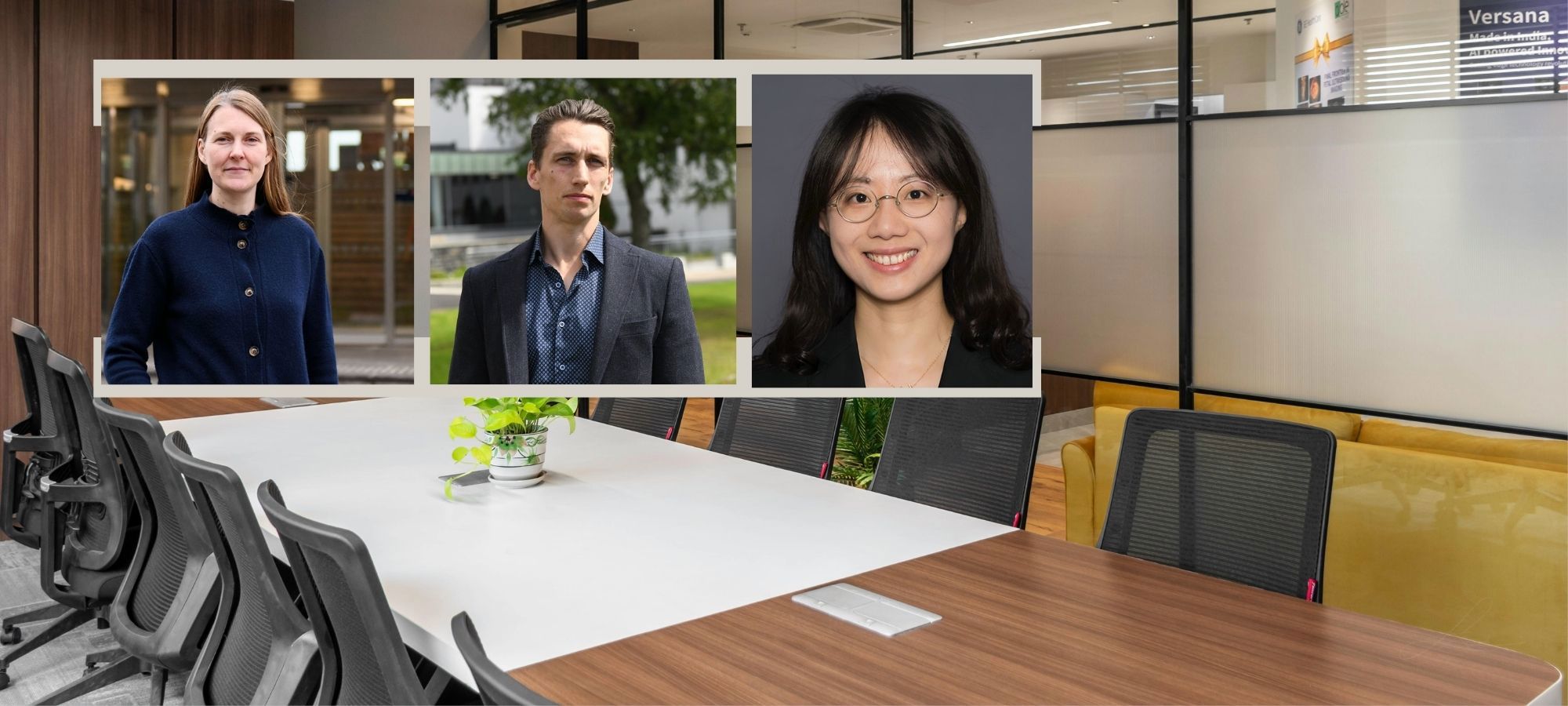
Professors Katrine V. Løken and Alexander Willén, and Postdoctoral Researcher Yaling Xu, are co-authors of the paper. All three are researchers at the Department of Economics and the Centre of Excellence FAIR.
The researchers conducted an extensive workplace survey through Norstat, collecting information about meeting activity in Norwegian companies. These data were then linked to administrative register data on earnings, occupation, employer and company finances. This provides a detailed picture of meeting activity and how it is associated with factors such as pay, learning and company performance.
And that is a conservative estimate.
Alexander Willén
`And that is a conservative estimate. The figures do not include preparation, travel time or follow-up work after meetings´, says Alexander Willén.
Most employees attend meetings at least once a week, and many attend several. But there are large differences. One in five employees spends more than eight hours a week in meetings.
Unsurprisingly, managers are by far the most frequent meeting participants. The same is true of highly educated employees and those in knowledge-intensive and professional occupations.
The researchers also find that employees who work remotely or in hybrid arrangements attend more meetings than those who mainly work in the office.
`One possible explanation is that formal meetings partly replace the spontaneous interaction that takes place around the coffee machine or in the corridors´, says Katrine Løken.
There are also clear differences between companies. Firms with high turnover and high wages spend more time and money on meetings than other companies, even though their employees’ time is also more costly.
This does not mean that meetings are what make these companies more productive.
‘Meetings’ (working paper, published in September 2026), by David J. Deming (Harvard College), Professor Katrine V. Løken, Professor Alexander Willén and Postdoctoral Researcher Yaling Xu (all three at NHH).
The study is based on a survey of more than 9,000 Norwegian employees, linked to administrative register data on wages, occupations, employers and company finances, among other factors. The researchers examine how frequently employees attend meetings, how much time they spend in them, what purposes the meetings serve, and how meeting activity relates to workplace learning, wage growth and company characteristics.
`We cannot establish that meetings themselves lead to better results. But the association is clear: companies with extensive meeting activity are often also companies that perform well´.
But what do we actually do in all these meetings? Planning, problem-solving, information sharing and project coordination account for most meeting activity, the study finds.
Employees in meeting-intensive workplaces report significantly more learning on the job than others. Contact with more experienced colleagues is also associated with stronger wage growth over time.
Meetings are much more than calendar clutter and status updates.
Katrine V. Løken
Greater knowledge transfer within the company is one possible mechanism.
`This suggests that meetings are not just about coordination and status updates. They also facilitate knowledge transfer, training and development´, says Alexander Willén.
The researchers examine a range of activities during the working day, including individual work, administration, email, travel and training.
Of these activities, participation in meetings has the strongest association with subsequent wage growth, Løken explains:
`Meetings are much more than calendar clutter and status updates. They may also be an investment in how knowledge is shared, how employees learn and how organisations work together´.
The researchers emphasise that they cannot establish a causal effect. They do not claim that holding more meetings leads to better company performance or higher wages for employees. But the study shows that meetings are closely linked to how modern organisations structure work, learning and collaboration.