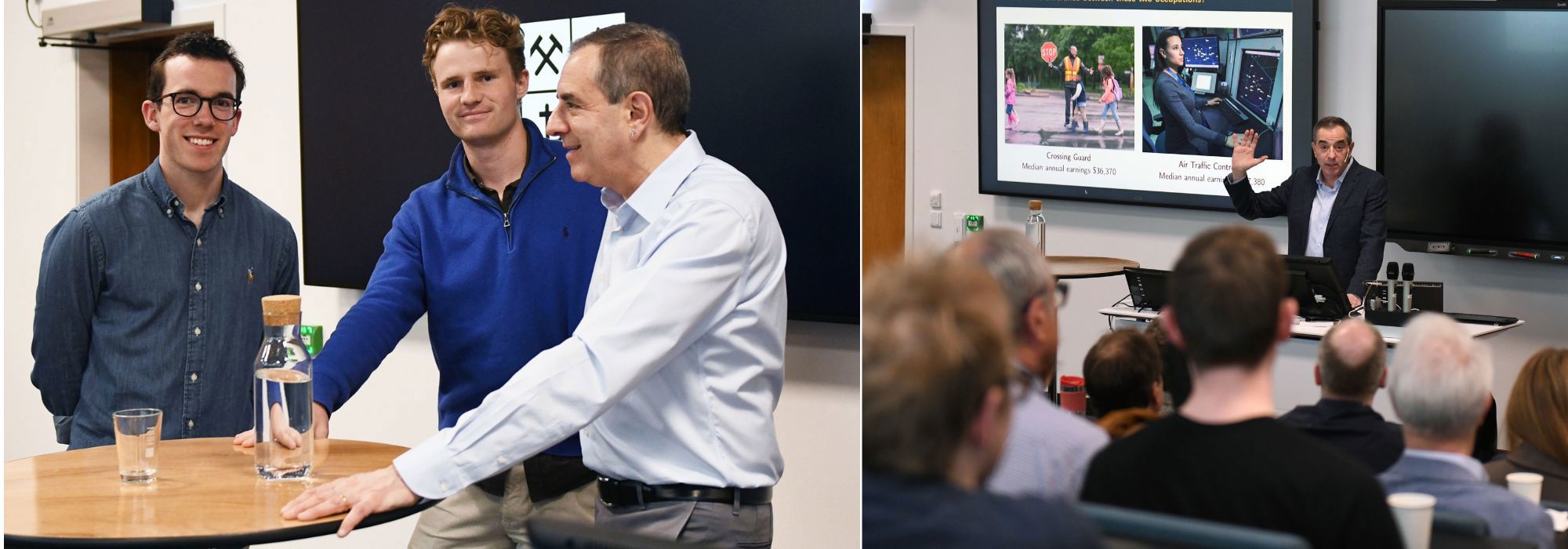
Students met David Autor: ‘It is about our future’
The MIT professor filled the auditorium when he gave the Sandmo Lecture on AI, work and expertise. Afterwards, he spoke with students.
- You can watch the recording further down in the article.
‘This is about what our future as students will look like,’ says first-year student Wilhelm Hatlen from Trondheim.
He and fellow student Anton W. Fladmark took a break from exam revision to hear one of the world’s leading labour economists speak about AI and the future of work.
It was MIT Professor David Autor who gave this year’s Agnar Sandmo Lecture last Friday. The lecture, “Expertise, Automation, and AI”, brought together researchers, staff and students.
‘Relevant to us’
‘I actually thought it would mostly be researchers and faculty members here, but the lecture sounded very interesting. So I made time for it,’ says Hatlen.
The two students still have two exams left. The next one is macroeconomics.
‘A lot of it seemed relevant. It was exciting to see what is happening now in relation to the syllabus. It is valuable to be able to connect the two,’ says Hatlen.
Agnar Sandmo Lecture
The Sandmo Lecture is held annually in honour of Professor Agnar Sandmo (1938–2019), one of Norway’s foremost economists and an internationally recognised scholar. The lecture is organised by the Department of Economics and led by Professor Kjell G. Salvanes.
Spoke with the students after the lecture
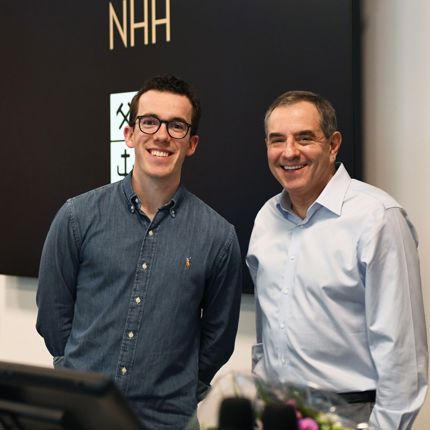
After the lecture, Autor also made time for a conversation with the two NHH students, Hatlen and Fladmark.
The two first-year students wanted to hear more about how AI may affect job opportunities for young people who will soon enter the labour market.
Autor emphasised that there is not only reason for concern. Many employers are now looking to recruit what he described as “AI natives” – people who are familiar with AI tools and know how to use them effectively.
Enormous opportunity
‘Many people do not really know how to use AI very well. In our case, it is often the PhD students who teach the rest of us how to use tools such as Claude in the research process,’ said Autor.
At the same time, he stressed that the development of AI involves real risk.
‘I do not mean to downplay that. But there is also an enormous opportunity,’ he said.
For Hatlen, this was one of the most interesting points.
‘He had a more positive view of AI than what you usually hear. That was pretty cool,’ says Hatlen.
The bachelor students found the link to the labour market particularly interesting. They do not feel that students are necessarily tired of hearing about AI.
‘It is a highly relevant topic, but I would not say that we are tired of hearing about it. It is about what our future will look like. That is why it is important to hear what people think about it.’
A tool, not just a threat
Much of the AI debate is about risk, automation and jobs that may disappear. Hatlen was left with a more nuanced impression.
‘With a solid education as a foundation, it seems that AI can be used more as a tool than as a threat to our job opportunities,’ says Hatlen.
Salvanes believes the topic goes to the core of what a business school must address in the years ahead.
‘For a business school, this is absolutely central. We educate candidates for a labour market where AI will change both tasks and skill requirements. We therefore need to understand what kinds of human expertise will actually become more valuable,’ says Salvanes.