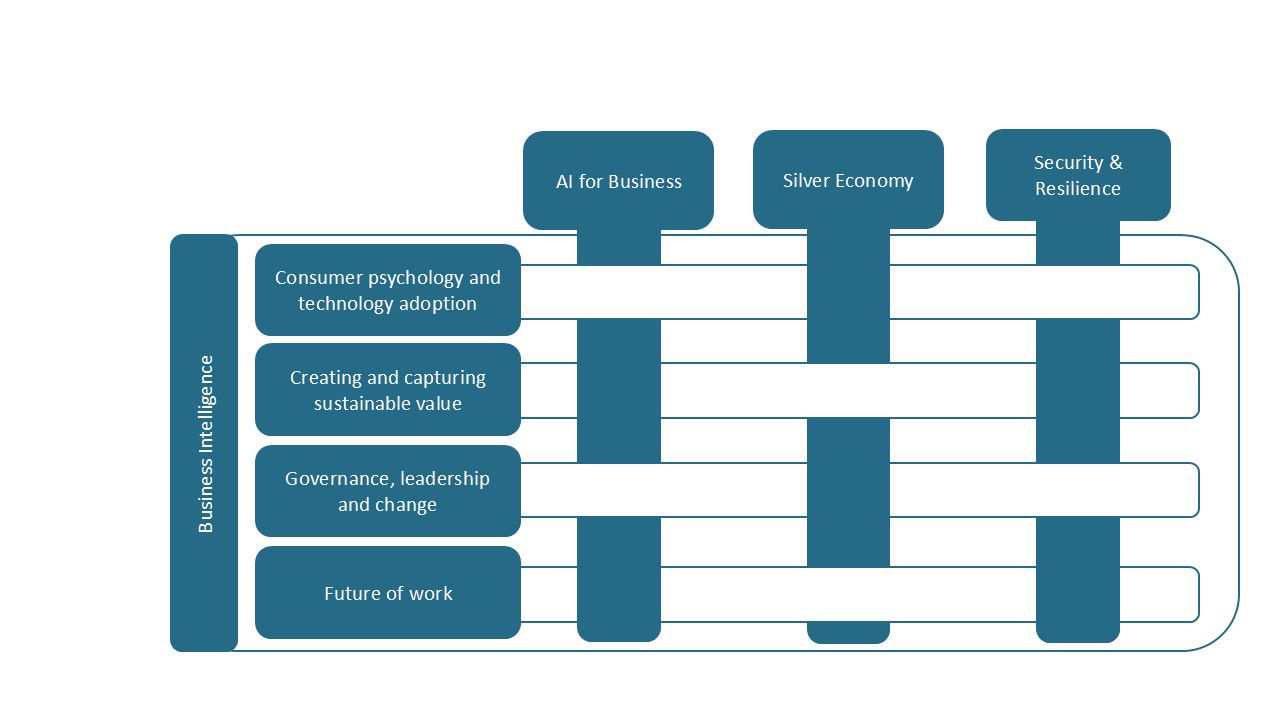
Societies around the world are experiencing profound changes, two of which stand out for their transformative impact on businesses, governments, and individuals. The first is the rapid advancement of Artificial Intelligence (AI) - a force reshaping organization and redefining the workforce. The second is the emergence of the Silver Economy, as aging populations become a defining characteristic of many developed nations, including Norway.
AI in Business - Artificial Intelligence promises to redefine how value is created, captured, and delivered across all sectors—from commercial enterprises to public institutions. While investments in AI technology continue to grow, the real test lies in integrating AI into organizational strategies and cultures. Leaders must address questions of how to effectively deploy and integrate AI, how to adapt workforce skill sets, and how to balance efficiency with critical considerations like data privacy and equity.
The Silver Economy - Over the coming decade, countries such as Norway are projected to become “super-aged” societies, with more than 20% of their populations aged 65 or older. This demographic shift carries significant economic and social implications. Employers face potential workforce shortages, while demand soars for products and services tailored to senior citizens, ranging from healthcare innovations to financial solutions. At the same time, responsibility for aging is increasingly shifting from government bodies to individuals, putting pressure on households and businesses to devise sustainable strategies for eldercare, employment, and societal well-being.
Security and Resilience – Geopolitical instability, digital vulnerability, and rising interdependence between public institutions, business, and society are reshaping how security and resilience are understood and managed. The Center for Security and Resilience at NHH addresses this as an arena for research, education, and cross-sector collaboration, with a focus on governance, organizational adaptation, innovation, and societal resilience. A key part of the initiative explores how AI-enabled decision support, learning, and technology transfer can strengthen preparedness and implementation in organizations operating under high uncertainty.
A Business Perspective - Neither of these challenges—AI disruption nor demographic transformation—can be addressed purely through technological or policy lenses. They demand expertise in strategy, economics, and organizational behavior, as well as leadership and ethical considerations. Ultimately, the key to addressing these grand challenges lies in recognizing that they are deeply rooted in how businesses and the economy function.
DIG as a consortium is skilled and motivated to help solve these challenges through research and practical cases from our partners.
How the research areas and grand challenges of DIG fit together.
RESEARCH AREAS
Business Intelligence
DIG aims to become Norway’s leading group for capturing the economic values of AI/ML technology in organizations’ downstream activities. We transform business challenges into data-driven solutions by converting qualitative requirements into quantitative analyses, leveraging advanced AI and machine learning methodologies to capture economic value and drive sustainable growth.
Principal Investigator: Ivan Belik. Research team: Nhat Quan Lie, Einar Breivik
AI and data-driven methodologies are transforming business decision-making, optimizing strategic processes, and generating economic value. Through collaboration between academic and industry partners, interdisciplinary approaches are developed to translate business challenges into data problems solvable through advanced analytics. Leveraging artificial intelligence, large language models (LLMs), and machine learning (ML), business intelligence is refined to transform complex organizational data into actionable insights.
State-of-the-art AI tools, natural language processing (NLP) techniques, and high-performance computing enable the analysis of large-scale business data. By detecting complex patterns and refining data-driven strategies, organizations can enhance efficiency, productivity, and competitive advantages across industries. Advanced AI infrastructure, including Norway’s first deep-learning-capable AI server, facilitates computationally intensive tasks, further driving innovation in business intelligence research.
As businesses navigate an increasingly digital landscape, AI and ML serve as essential tools for sustainable growth. From improving data collection and integration to optimizing strategic decision-making, AI-powered business intelligence provides robust solutions that help organizations unlock their full potential.
Key questions include:
What methodologies can effectively translate business challenges into data science/analytics problems?
How can qualitative business requirements be seamlessly integrated with quantitative data analyses?
What are the challenges and solutions associated with big data, including prediction accuracy, data quality, GDPR compliance, and limited data scenarios?
How can AI and large language models (LLMs) improve the accuracy and efficiency of data analysis in business intelligence?
Consumer psychology and technology
We investigate consumer psychology, moral decision-making, and how beliefs shape behavior in markets transformed by technology and demographic shifts. This provides actionable insights for both private and public sectors to design, implement, and manage innovative digital services.
Principal Investigator: Jareef Bin Martuza Research team: Helge Thorbjørnsen, Aruna Divya Tatavarthy
Understanding human judgment and decision-making is key to digital innovation and sustainable business practices. New digital services are of little value unless they are adopted and used by organizations, clients, and consumers. As most new products and services fail in the marketplace, both commercial firms and government institutions must first understand the psychology of technology and moral decision-making in digital contexts.
DIG research focuses on how organizations can increase commercial success by lowering consumer adoption barriers, removing uncertainty, and ‘nudging’ consumers to effectively change their behavior. Together with industry partners, DIG offers new knowledge, perspectives, and tools for understanding and influencing how consumers think and act in digital environments and beyond.
Current Projects:
Consumer trust and morality: When and why consumers behave dishonestly, and how organizations can build and maintain trust in digital environments characterized by misinformation, deception, and polarization.
Beliefs versus reality: How consumer and manager beliefs about others and the external world match reality, and its implications for interpersonal and marketplace decision-making.
Time and well-being: How do people think about and spend time, and what actually makes people happy?
Creating and capturing sustainable value
How can firms integrate strategic technologies, adapt organizational structures, and innovate their business models to create and capture sustainable value in response to two transformative global challenges — AI's disruptive impact and the rise of the Silver Economy.
Principal Investigators: Lasse B. Lien, Tina Saebi, Bram Timmermans Research team: Eirik Sjåholm Knudsen, Björn Schmeisser, Vidya Oruganti, Frank Elter, Kristina Heinonen, Seidali Kurtmollaiev, Line Lervik-Olsen, Magne Angelshaug, Tor W. Andreassen
In an era of rapid technological change, remaining competitive requires more than simply adopting new digital tools. True value emerges when these technologies are strategically integrated into business models, organizational structures, and innovation processes. While emerging technologies offer opportunities for efficiency gains and market differentiation, their widespread availability makes it essential to combine them with complementary assets, capabilities, and innovations to achieve sustained competitive advantages. However, many organizations face challenges in aligning technological adoption with broader business transformation, limiting their ability to fully capture long-term value.
Competitive advantages through strategic technology adoption can be achieved through three key pathways:
Strategic integration – Embedding digital technologies within operations to enhance efficiency, innovation, and value creation.
Technology differentiation – Gaining a competitive edge by developing or accessing proprietary technologies, unique data sources, or specialized expertise.
Hybrid advantages – Combining technological advancements with organizational capabilities and complementary assets to build long-lasting competitive advantages.
Key research questions
How can firms effectively integrate digital technologies with complementary assets, capabilities, and innovations to enhance their business models and organizational infrastructure?
What strategies enable firms to develop or access superior digital technologies that provide a competitive edge?
How can firms combine technological advancements with complementary assets and capabilities to create hybrid competitive advantages?
How can firms leverage digital technologies to address sustainability challenges while remaining competitive?
Governance, Leadership and Change
We investigate how governance and top-level leadership foster necessary transformation and build long-term capacity for change and innovation in the face of AI’s disruptive potential and the opportunities in the emerging Silver Economy.
Principal Investigator: Inger G. Stensaker Research team: At NHH: Therese Egeland, Jonas Hammerschmidt, Dorotea Rossi Kriscak, Lasse Lien, Bram Timmermans, Rune Bjerke At SNF/AFF: Researchers: Synnøve Nesse, Thora Lou, Marius Jones
Responding to shifting societal and technological realities (such as AI and the aging population) invariably implies business transformation among firms and industries. These macro-level developments create opportunities for new and emerging entrepreneurs and industries while requiring strategic change, innovation and reorientation among existing firms and industries. These types of strategic change have proven particularly challenging for well-established firms with a history of success, as they tend to become constrained by structural and cultural inertia (often referred to as the success paradox). In this stream of research, we investigate how governance and top-level leadership foster necessary transformation and build long-term capacity for change and innovation in the face of AI’s disruptive potential and the opportunities in the emerging Silver Economy.
Key questions include:
How do governance structures—encompassing boards, chairs, and CEOs—shape strategic transformation and innovation for sustainable growth in the face of shifting societal and technological realities?
How can top-level executives navigate internal and external pressures, sustain momentum for change, and foster organization-wide engagement amid shifting societal and technological realities?
In what ways does ownership structure (e.g., private, public, non-profit, private equity) influence decision-making processes and the success of transformative efforts?
How can organizations effectively align multiple transformative changes while adapting their strategies, structures, and behaviours to capitalize on emerging demographic and market opportunities?
Future of work
We investigate how AI-driven transformation and the Silver Economy combine to reshape workforce dynamics, skill demands, and labour market structures from organizational, individual, and policy perspectives.
Principal Investigator: Therese Egeland Research team: Karen Modesta Olsen, Alexander Madsen Sandvik, Vidar Schei, Bård Fyhn and Christer Andre Flatøy
The research group aims to explore how AI-driven transformation and the silver economy are reshaping the future of work, with a focus on aging populations and technological advancements. By examining strategies to empower senior employees, leveraging emerging technologies to enhance quality of life, and adapting HR systems to demographic and technological shifts, the research seeks to foster inclusive, productive, and meaningful work environments. Ultimately, the goal is to ensure that innovations like AI and flexible work arrangements align with the evolving needs of older individuals while promoting health, happiness, and organizational performance.
Key questions:
How can evidence-based strategies be developed and implemented to empower senior employees to actively shape their careers, promoting happiness, health, and productivity in their later career stages
How do flexible work arrangements, including remote work, digital solutions, and flexible employment relations, impact the length and quality of working lives from an individual perspective, particularly in terms of health, work-life balance, productivity, and job satisfaction?
How are the needs and preferences of individuals aged 65 and older evolving, and in what ways can emerging technologies be leveraged to support these needs, enhance quality of life, and extend the period of independent living for this demographic?
AI as a team member - What practical strategies can managers implement to effectively leverage AI in order to enhance team dynamics and improve overall organizational performance?
How can HR-systems adapt to technological advancement and challenges of an aging population?
DIG Selected Publications
Authors
Title
Publication
Caruelle, D. S. S., Shams, P., Gustafsson, A. & Lervik-Olsen, L.
Sandvik, A. M. m.fl. (2025): Sometimes collaboration is the better strategy: Institutional context and the calculative and collaborative HRM-performance relationship in the Nordics, 1999-2021.
Timmermans, B. m.fl. (2025): Workplace diversity and innovation performance: Current state of affairs and future directions. Oxford University Press.
Sjåstad, H.; Skard, S.; Thorbjørnsen, H. m.fl. (2025): Selv-serving optimism in well-being prediction: People believe in a bright future for themselves and their friends, but not for their enemies. European Journal of Social Psychology.
Stensaker, I. G.; Friesl, M. (2025): Strategic Change. Elgar Encyclopedia of Strategy as Practice.
Døskeland, T.; Martuza; Pedersen, L. J. T.; Santos, F.; Sjåstad, H.; Thorbjørnsen, H. (2025): The role of social norms in retirement saving: Evidence from two natural field experiments. Journal of Business Research, Volume 190, March 2025, 115201.
Angelshaug, M. S.; Saebi, T.; Foss, N. J. (2025): Steering managerial attention towards business model innovation: The role of organizational design. Journal of Business Research.
Harutyunyan, T.; Timmermans, B.; Frederiksen, L. (2025): Outside board director experience and the growth of new ventures. Journal of Business Venturing, Available online 4 March 2025, 106484.
Benoit, S.; Merfeld, K.; Tunn, V.; Schaefers, T.; Andreassen, T. W. (2025): The B2B Sharing Economy: Framework, Implications, and Future Research. Journal of Business Research, Vol. 191.
Torgnes, C.; Non-Competes Are a Double-Edged Sword. Entrepreneur & Innovation Exchange Published online at EIX.org on June 21, 2023, DOI: 10.32617/927-6493017bb0451
Stensaker, I. G. (2023): Endring og omstilling. Kapittel 15 i Einarsen, S., Martinsen, Ø.L. & Skogstad, A. (eds) Organisasjon og Ledelse 2.utg. Gyldendal Akademisk. (Book chapter includes video and teaching cases