
ICA: Biggest but not best
ICA Sweden was unbeatable for most of the last 50 years, not anymore. What went wrong? Many analytics and journalists believe that the overconfidence in its own strength and history became too deep. Consequently, the board and administration have not acted quick enough on market changes the last ten to twenty years.
ICA is in one of its most demanding phases in decades. After years of squeezed margins, falling market shares and increasing competition from both low-price and premium, the group has taken a dramatic step: the sale of Rimi Baltic in 2025 and big losses in Norway in 2014.
Now the board can concentrate on Sweden only. The problem however is not primarily the competitors. It is ICA's own strategic uncertainty.
Customers vote with their feet
Today, ICA appears caught between two worlds. The price level is too high to compete with Willys, and the concept is too unclear to match Hemköp and Coop in profile and shopping experience.
The result is a position that is no longer given for Swedish households. When prices vary significantly between stores, and the campaign logic is perceived as unpredictable, trust weakens – and customers vote with their feet, and shop at Axfood.
The franchise model, long ICA's pride, has maybe also become a hindrance. Local ownership provides commitment but also creates major quality differences. In an era where competitors are standardizing and streamlining, ICA appears uneven and at times outdated.
If the group is to succeed, a new balance must be set up between freedom and management. Clearer requirements for operations, assortment and financial key figures are not an attack on the merchants – they are a prerequisite for preserving the model.
Store network needs rebranding
The store network is another weakness. Many ICA Supermarket and ICA Nära stores bear the hallmark of being products of the eighties. Modernization can no longer be a long-term project. It must be an urgent measure. Some stores must be upgraded, others rebranded – and some closed down.
At the same time, ICA's greatest opportunity lies in e-commerce and logistics. Here, the group has a significant backlog. Coop and Axfood are investing heavily in automation and integrated solutions. ICA must do the same – and preferably faster. The capital from the Baltic sales should provide financial room for investments in infrastructure.
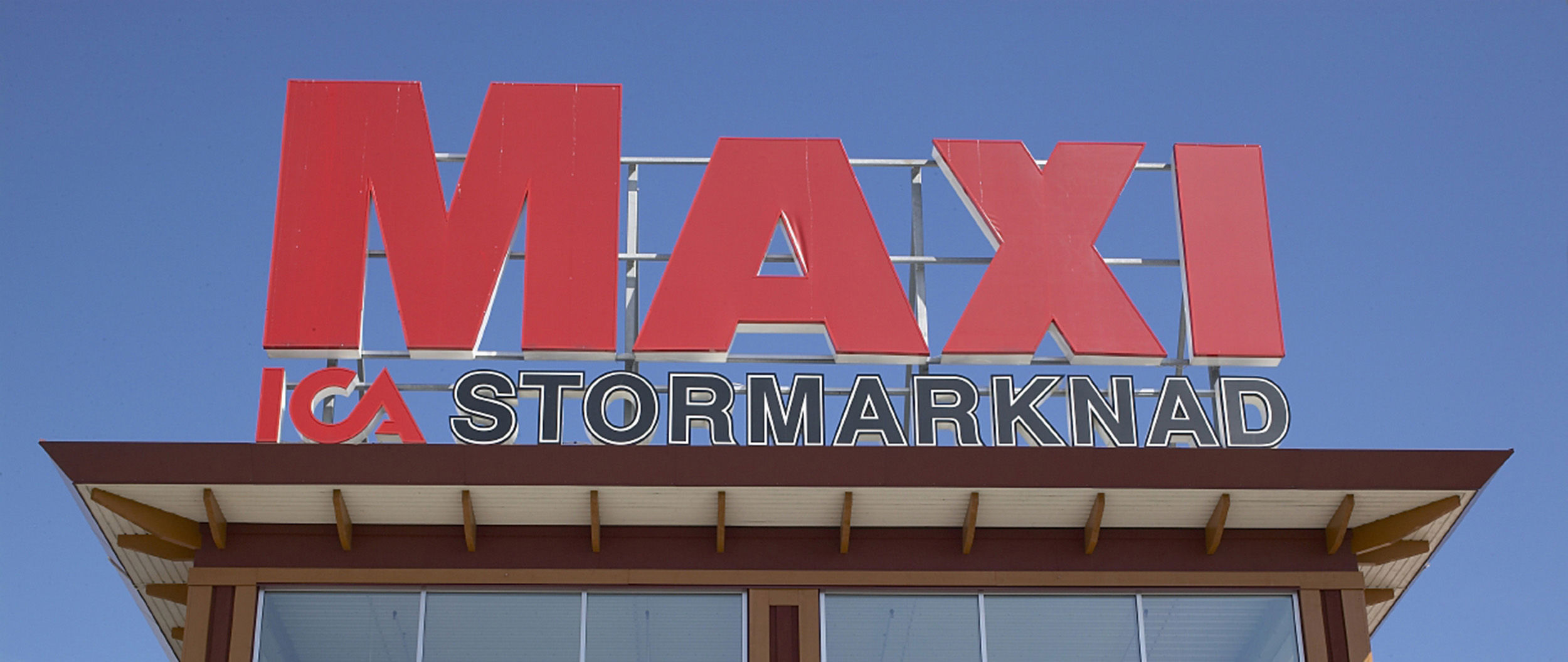
Maxi is maybe ICA's strongest card, but its potential is far from being exploited. Maxi should be the group's innovation engine, the place where new concepts are evaluated and scaled. Today, the format is used too defensively.
ICA is at a crossroads. If the group is to regain its position, it must choose clarity over compromise. This means a clear pricing strategy, a more controlled franchise model, a modernized store network and an offensive focus on logistics and e-commerce. The opportunities are there. The question is whether ICA and its leaders dare to seize them.
Status in the Swedish market
ICA – still the largest, but slightly declining
- Market leader with around half of the market.
- Has lost a few percentage points in recent years, pressured by price-focused concepts (Willys, Lidl).
- Strong store structure, but less growth than competitors.
Axfood – the growth winner
- Has significantly strengthened its position, both organically (Willys) and structurally (acquisition of Bergendahls/City Gross).
- Axfood is now one of two dominant players in Swedish grocery along with ICA.
- Willys is the country's strongest low-price chain, driving most of the growth.
Coop – stable, but without growth
- Part of the "big three" that control ~90% of the market.
- Has not taken market share in recent years.
- Has lost money for decades – survives by easing the balance. Soon there will be nothing more to sell.
Lidl – growing, but still small
- Discount chains have generally had difficulty proving themselves in Sweden compared to the rest of Europe.
- Lidl is growing, but from a low base and without threatening the big three.
- Has strengthened its price profile in a market with high inflation and a price focus.
Sources: ICA, Axfood, Coop, Salling, HUI, Aftonbladet, NHH etc.