
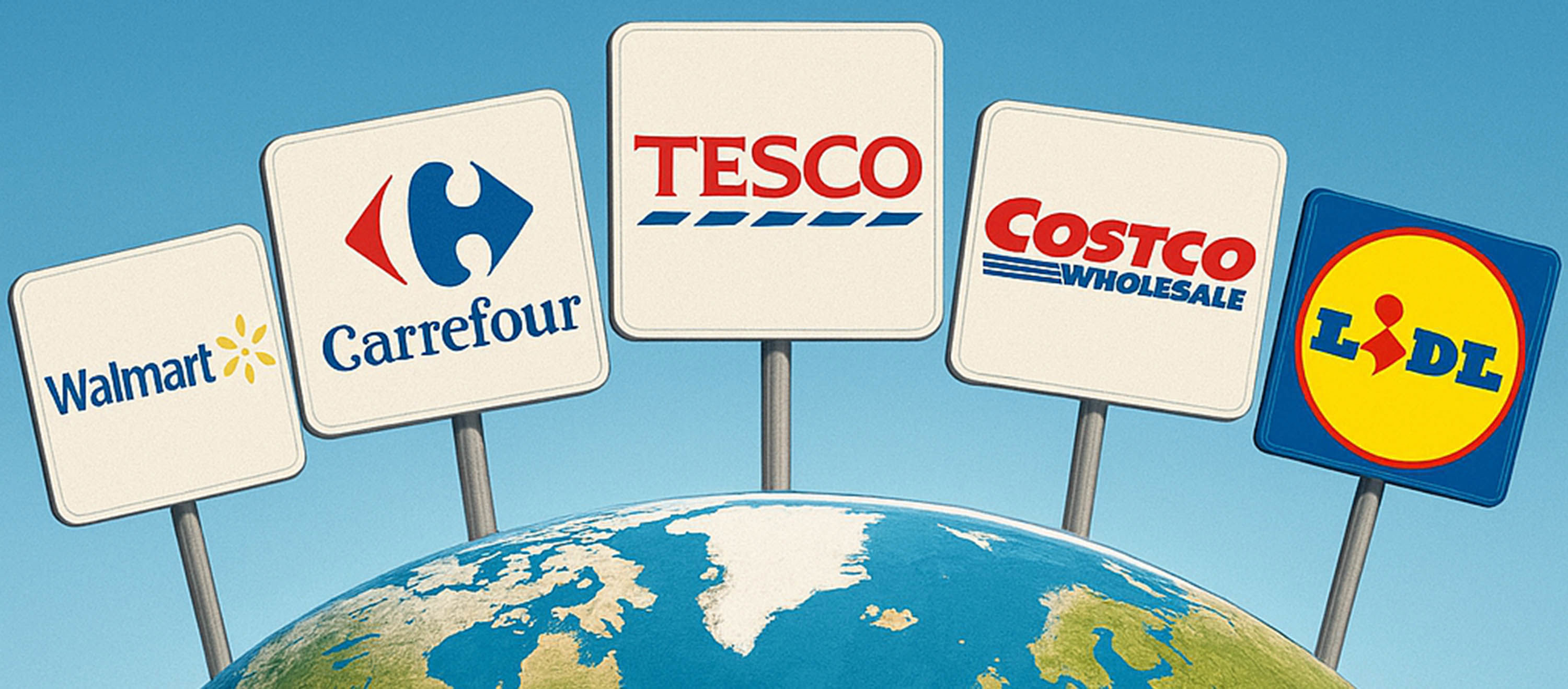
Global Grocery Giants Reshape Retail in 2025
The international grocery business has undergone significant transformation in 2025, as inflationary pressures, digital innovation, and sustainability demands continue to reshape strategies for the world’s largest retailers.
Walmart, Carrefour, Tesco, Costco, and Lidl have each made decisive moves to defend market share and adapt to shifting consumer expectations. We analyse global developments in 2025 and will paint with a broad brush.
Inflation Fuels Discount Competition
Rising food prices across Europe and North America have intensified competition among discount chains. Lidl and Aldi emerged as major winners, expanding aggressively in the United States and Eastern Europe. Lidl’s private-label penetration now exceeds 80 percent of sales, underscoring the strength of its lean, low-cost model. Tesco responded by expanding its “value ranges” and using its Clubcard loyalty program to keep pace in the UK’s supermarket price wars.
Walmart Maintains Global Leadership
Walmart kept its crown as the world’s largest retailer, according to the National Retail Federation’s 2025 rankings. The company strengthened its omnichannel presence by integrating AI-driven inventory systems and expanding same-day delivery partnerships. Walmart’s international operations in Mexico, Canada, and China also benefited from these innovations, reinforcing its reputation for supply chain mastery.
Carrefour Bets on Sustainability
French giant Carrefour doubled down on sustainability initiatives, rolling out eco-friendly packaging and expanding local sourcing programs. The retailer also accelerated its Latin American operations, particularly in Brazil, where hypermarkets are still resilient against discounters. Carrefour’s digital transformation continued with expanded click-and-collect services, positioning the brand as a hybrid between traditional hypermarkets and modern e-commerce.
Tesco Powers Data and Loyalty
In the UK, Tesco leaned heavily on its Clubcard loyalty program, which has become a powerful tool in tailoring promotions and defending against Lidl and Aldi. Over the past year, Tesco invested in AI-powered personalization for online shoppers, ensuring that its digital channels stay competitive. While Tesco has scaled back in some international markets, it is still influential in Central Europe and Asia.
Costco Expands Membership Model
Costco continued to thrive on its membership-based bulk retail model, surpassing 130 million households worldwide in 2025. The company expanded in Asia, opening new warehouses in Japan, Korea, and China. Costco also introduced more organic and sustainable product lines, responding to consumer demand for healthier options. Its Kirkland private label grew strongly, reinforcing Costco’s reputation for quality at scale. The American discount chain first set up itself with a store in Täby (outside Stockholm) in 2022, and has since opened its first large, self-built department store in Malmö/Burlöv in the summer of 2025.
Key Trends Defining 2025
- Discount dominance: Lidl, Aldi, and Tesco’s value ranges captured price and inflation-conscious shoppers.
- Omnichannel growth: Walmart, Carrefour, and Tesco expanded online grocery and delivery services.
- Sustainability: Carrefour and Costco emphasized eco-friendly packaging and sourcing.
- Private labels: Lidl, Aldi, and Costco strengthened their private-label portfolios, boosting margins and loyalty.
- Global expansion: Costco in Asia, Lidl in the U.S., Carrefour in Latin America.
- Australia (15 warehouses) is technically outside Asia but part of Costco’s regional strategy.
Outlook
As 2026 approaches, the grocery industry faces a delicate balance between affordability and innovation. Inflation has made discount formats more attractive, but digital convenience and sustainability are no longer optional—they are expected. Walmart leads with logistics, Carrefour with sustainability, Tesco with data, Costco with membership, and Lidl with discount disruption. Together, these giants illustrate how global retail continues to reinvent itself in response to consumer demand.
Dual criticism
Walmart, Lidl, Tesco, and Carrefour face dual criticism: environmental and social. On climate, they highlight plastics and food waste while ignoring the largest emissions—meat and dairy—responsible for up to 90% of their footprint. Reports show no clear targets to reduce methane from livestock, exposing a gap between promises and impact. Socially, they are accused of suppressing unions, keeping wages low, and rewarding executives disproportionately. Together, these critiques reveal chains that prioritize image management over substantive responsibility. Sustainability slogans ring hollow when workers are underpaid and the biggest climate culprits remain untouched, leaving credibility in question.
Sources: National Retail Federation – Top 50 Global Retailers 2025, Carrefour, Tesco, Costco, Lidl & Aldi Expansion Reports 2025, Walmart Reports 2025.