If the facility is foreign-owned, a significant share of the returns may accrue to owners outside Norway.
Øivind A. Nilsen

`As more and more players compete for scarce Norwegian electricity, we need to ask which data centres Norway actually benefits from´, says NHH Professor Øivind A. Nilsen.
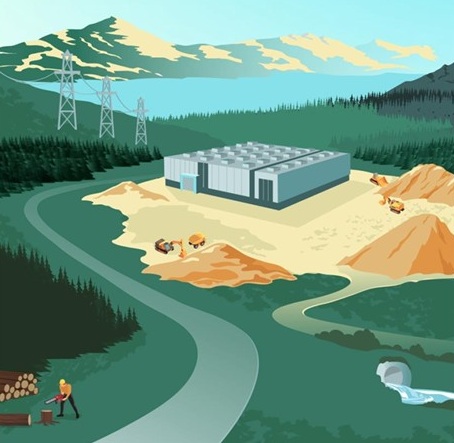
Illustration taken from the report.
This week, the Norwegian Board of Technology’s expert group published the report Data Centres in Norway – Assessments of Societal Benefit.
Without data centres, large parts of the digital society would grind to a halt. They store and process data and play a crucial role in cloud services, public-sector IT systems, research and AI.
At the same time, data centres require ever more electricity and grid capacity.
`New data centre developments draw on the same scarce resources that other Norwegian businesses need. Unless we make clearer priorities, Norway risks ending up with data centres that crowd out other uses without contributing to digital sovereignty, security, or local and national value creation´, says Øivind A. Nilsen
He is a member of the Norwegian Board of Technology’s expert group. Nilsen is Professor at the Department of Economics and head of the Macro, Risk and Sustainability Centre at NHH.
The new report provides a knowledge base for improving the regulatory framework for data centres in Norway. It also describes how the data centre industry has developed and explains the concepts and mechanisms needed to understand how data centres operate.
Since 2019, the grid capacity available to data centres has increased more than sevenfold, and data centres now account for a large share of the queue for new grid connections.
`We are not discussing whether Norway should have data centres. The question is which data centres we want to use scarce Norwegian resources for´, says Nilsen.
If the facility is foreign-owned, a significant share of the returns may accrue to owners outside Norway.
Øivind A. Nilsen
One of the issues highlighted by the expert group is foreign ownership.
Today, foreign companies own more than 90 per cent of Norway’s data centre capacity, according to the Norwegian Board of Technology. Tydal Data Center in Trøndelag is set to become the country’s largest and is operated by Bitdeer Technologies Group, which is headquartered in Singapore.
The expert group points out that data centres can involve substantial investment and high electricity consumption in Norway without a corresponding share of the value creation remaining in the country.
`If the facility is foreign-owned, a significant share of the returns may accrue to owners outside Norway´.
The expert group also discusses how many jobs are actually created once the facilities are up and running. Most jobs are generated during the construction phase, and these are largely temporary. According to Statistics Norway, the data centre industry directly employed 677 people in 2024.
`If two projects both want 100 megawatts, but one creates few jobs and has little strategic value, while the other provides important AI capacity, resilience or substantial spillover effects in Norway – should they be treated equally in the power system?´ asks the NHH professor.
In September 2026, data centre projects amounting to around 8,800 megawatts were in Statnett’s queue.
Data centres accounted for 56 per cent of the entire waiting list for projects seeking access to the grid. The queue is therefore more than eight times larger than the capacity already connected for data centres.
Many of the projects in the queue will never be realised.
Øivind A. Nilsen
`This is not a forecast of actual electricity consumption. Many of the projects in the queue will never be realised. The figures nevertheless show the scale of demand and how intense the competition for electricity and grid capacity could become´.
This is happening at the same time as existing Norwegian industry is being electrified, while new industrial projects, transport and other parts of society also require more electricity.
One of the report’s main points is that data centres are not all the same type of business.
Large data centres can require very large amounts of electricity while creating relatively few permanent jobs. Other data centres may have strategic value because they provide critical digital services, store data of societal importance, or give Norwegian businesses, researchers and the public sector access to cloud services and AI capacity.
The report therefore identifies several factors that should be considered when assessing societal benefit: use of electricity and grid capacity, value creation and employment, digital benefits, security and resilience, and impacts on local communities.
The report Data Centres in Norway – Assessments of Societal Benefit will provide a knowledge base for the Norwegian Board of Technology’s further work on how data centres should be regulated in Norway.