I think almost everyone who wants to write about business model innovation now has to cite us.
Tina Saebi

Tina Saebi is NHH's most-cited female professor on Google Scholar. She is now concerned about how artificial intelligence will affect the next generation of researchers.
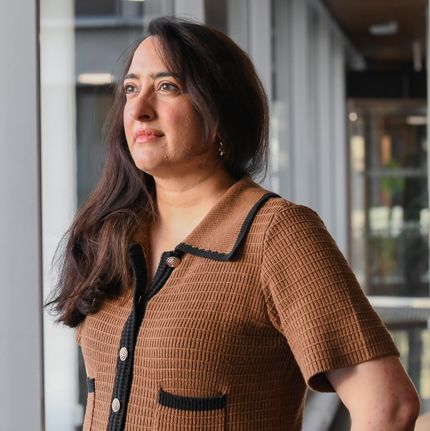
‘The citations are concentrated in four papers,’ says Tina Saebi, Professor at the Department of Strategy and Management.
She has passed 10,000 citations on Google Scholar, and keeps an eye on how the number develops.
‘I check my Google Scholar citations from time to time. It's fun to see how they're developing.’
Behind the impressive figures lie many years of work.
‘I've spent so many years of my life writing these papers. I'm happy that people are reading them, and I hope they find them useful,’ says Saebi, adding:
‘Of course, when we wrote these earlier papers, we didn't have AI. But I can confidently say that I'm an expert in the field because I've read everything myself. I've had to think things through and reflect on what I've read.’
She is now concerned that extensive use of artificial intelligence could mean that young researchers miss out on precisely this time-consuming process of reading, understanding and reflecting on research.
I think almost everyone who wants to write about business model innovation now has to cite us.
Tina Saebi
‘I'm a little worried about the next generation of researchers. If they rely so much on AI, how will they ever become experts?’ asks Saebi.
The star of her publication record is Fifteen Years of Research on Business Model Innovation, published in the Journal of Management.
The paper has now attracted around 4,200 citations on Google Scholar (see fact box). When it was published in 2017, business model innovation was a rapidly developing field of research. Saebi and her co-author, Nicolai Foss, brought together and systematically reviewed the existing literature.
‘The timing was very good. That's why the paper was so widely read and cited.’
The paper has had considerable influence.
‘I think almost everyone who wants to write about business model innovation now has to cite us, because the paper has practically become a standard reference in the field.’
Saebi specialises in business model innovation: developing new ways of creating value and generating revenue. This can involve changing how a company delivers products and services, reaches customers or earns money.
‘A well-known example is Airbnb, which has developed a business model that connects people who want to rent out their homes with people looking for accommodation, without owning the properties themselves.’
The study reviewing fifteen years of research on business model innovation has helped many early-career researchers, including PhD students.
‘It gives them a good overview of the field. They understand the shortcomings in the research, the assumptions it is based on, and perhaps some of the paradoxes. We also suggest directions for future research.’
Others have to cite us because they disagree with us! That's nice too.
Tina Saebi
‘Others have to cite us because they disagree with us! That's nice too.’
Another of Saebi's highly cited papers is a review of research on social entrepreneurship. Social Entrepreneurship Research: Past Achievements and Future Promises was also published in the Journal of Management (2019), which has a four-star rating in the ABS Academic Journal Guide.
The researchers reviewed no fewer than 395 academic papers on social entrepreneurship and developed a framework to improve understanding of the field.
‘I think people appreciate these kinds of papers. If you're a PhD student trying to familiarise yourself with the field, you would otherwise have to read a huge number of different articles. We give them a comprehensive overview.’
Saebi is now applying the same approach to a new field of research.
Together with her NHH colleague Vidya Oruganti, she is examining research on ‘collective action’ – how individuals, organisations and governments work together to address shared challenges or bring about social change.
It's a really exciting topic, and Vidya was the one who initiated the project.
Tina Saebi
‘It's a really exciting topic, and Vidya was the one who initiated the project.’
The researchers have reviewed approximately 800 papers from different academic disciplines. Their aim is to bring the insights together into a single framework.
The work is extensive. Nevertheless, they have chosen not to use artificial intelligence to write their paper.
‘AI is useful because it can give you a summary of a paper. But if you haven't read it yourself, how can you fully understand it?’ Saebi concludes.