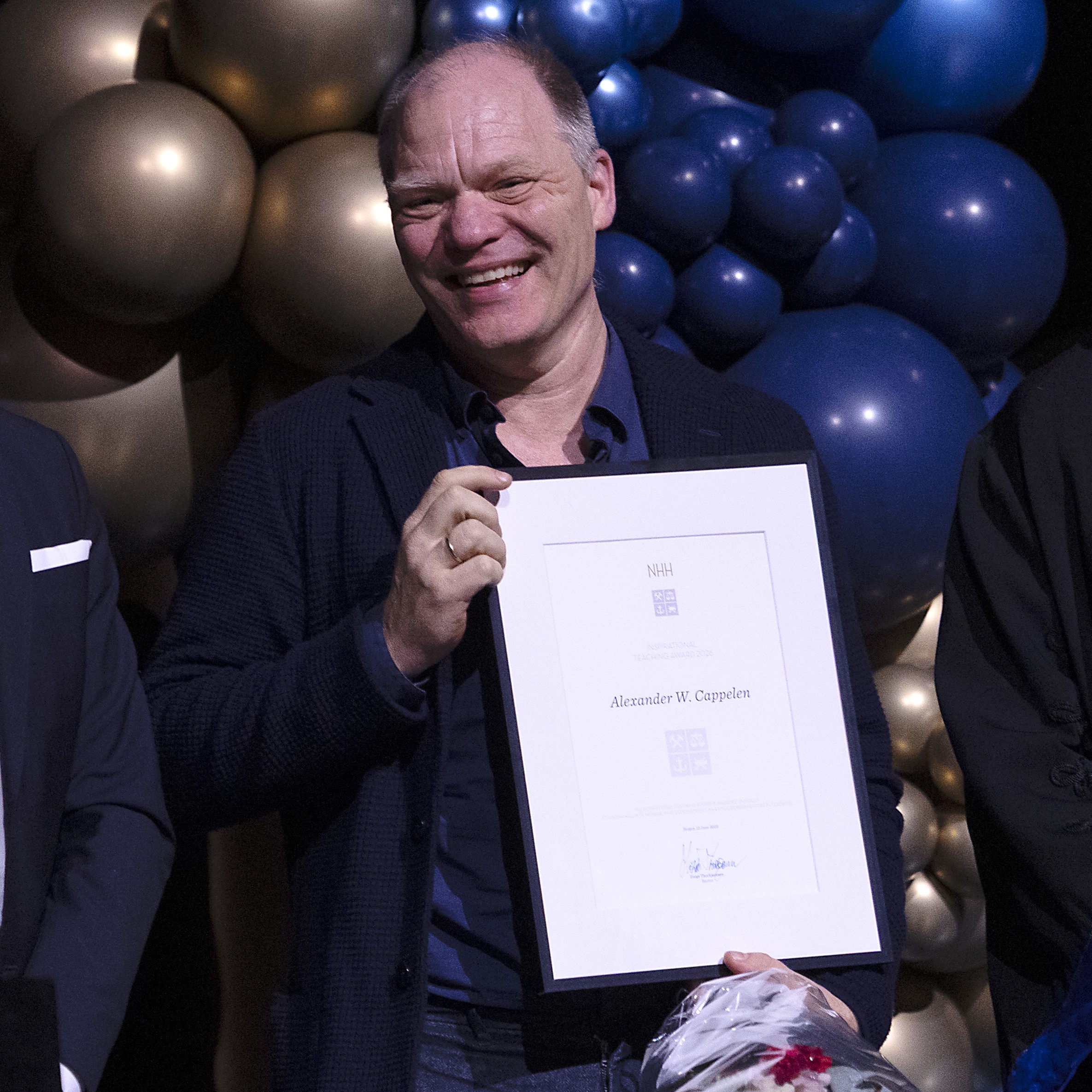
This award tells me that students like being challenged in this way.
Joel Berge
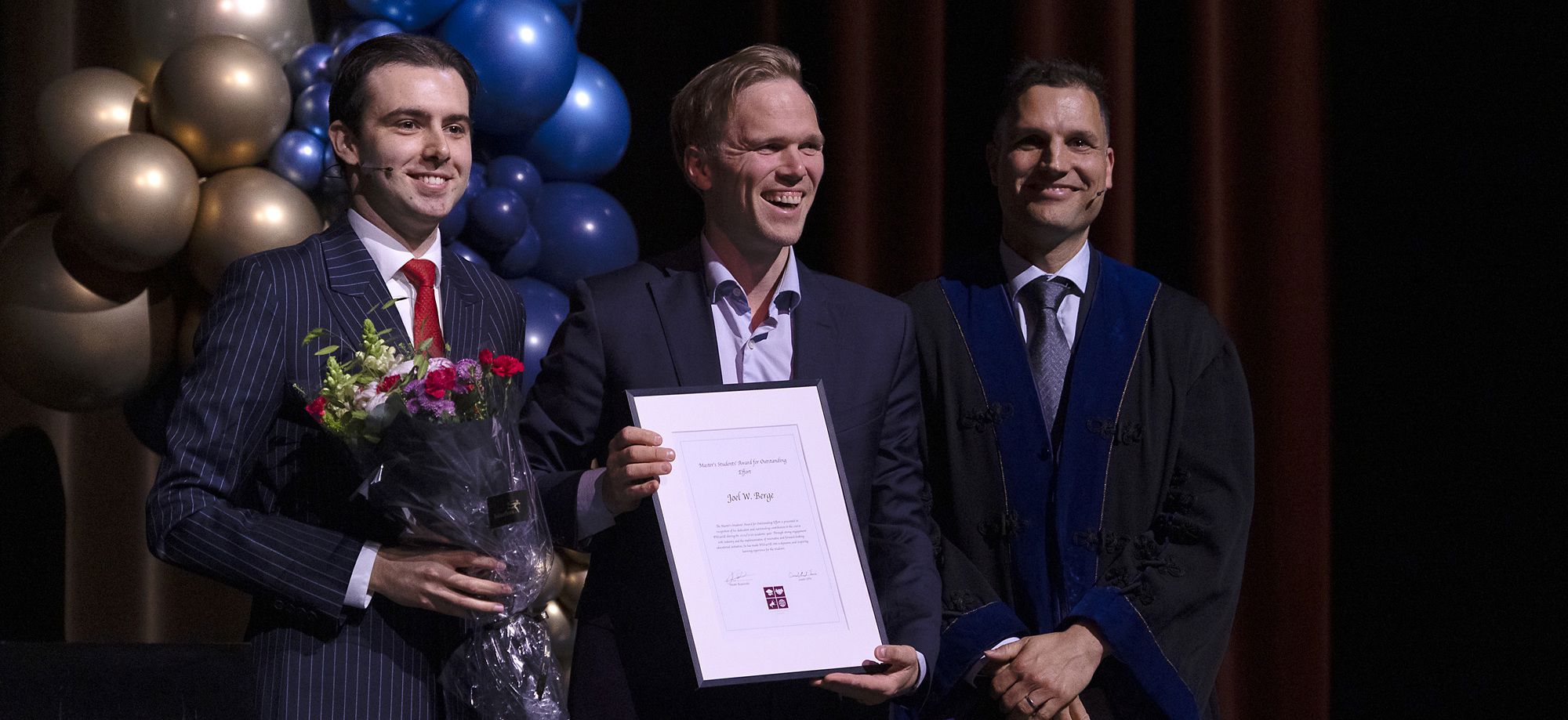
Joel Berge let his master’s students work with real data, AI and a real-life problem from Akvariet. They rewarded him with an award for excellence in teaching.
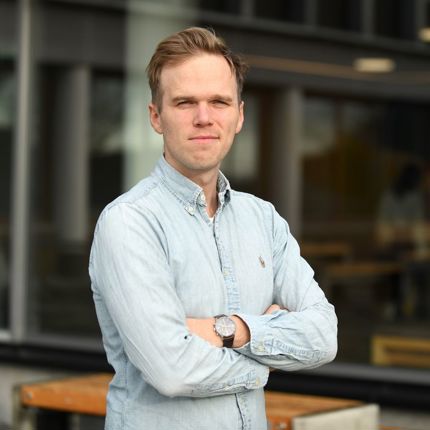
‘He has a unique ability to bridge academic knowledge and working life,’ says master’s student Aviv O. Benhamou.
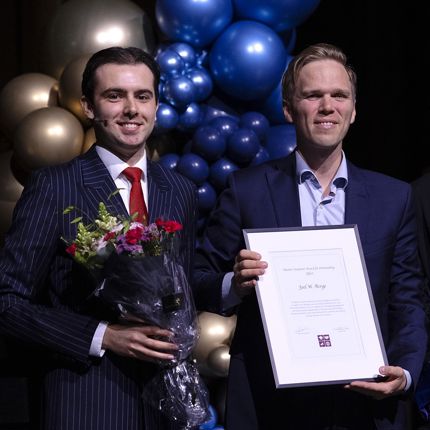
On Friday, Joel Berge was honoured during the master’s degree ceremony at Grieghallen. On behalf of NHH’s students and the Student Political Committee, Benhamou presented this year’s Award for Excellence in Teaching.
Berge, Associate Professor at the Department of Accounting, Auditing and Law, received the award for his teaching in the BUS course Strategic Profitability Analysis.
‘I was genuinely surprised,’ says Berge.
The course is about firms’ profit potential, and how to assess whether a firm is actually realising that potential. In Berge’s version, this means more than theory, models and paper-based cases.
This award tells me that students like being challenged in this way.
Joel Berge
The students have to engage with real-life problems, incomplete answers and data that do not always behave as expected.
In this year’s course, the students collaborated with Akvariet in Bergen throughout the semester. Akvariet shared real data with the students and asked them to solve a real-life problem.
In the final week, the groups presented their solutions directly to Akvariet’s management. The students were allowed to use AI in their work, but had to defend their analyses orally when Akvariet asked questions.
Because the group assignment was not graded, Berge promised that the exam would also focus on Akvariet. The effort the students put into the group work therefore became directly useful when they sat the exam on their own.
‘As a lecturer, you are often a little unsure whether students actually appreciate being thrown in at the deep end, or whether they would rather have order and predictability. This award tells me that students like being challenged in this way – at least this cohort,’ says Berge.
To be completely honest, this was a classic case of necessity being the mother of invention.
Joel Berge
Berge took over the course from Trond Bjørnenak in 2021.
‘To be completely honest, this was a classic case of necessity being the mother of invention. Trond has extensive experience from business and has always had good, practical examples for the students to work with,’ says Berge.
Berge wanted to develop the course further. In 2022, he invited Lagunen Kino into the course, allowing the students to apply pricing theories to the cinema’s new subscription model. Later, the students worked with Bergen Kino and the Fløibanen restaurant.
‘What was different this year was that Akvariet was involved throughout the entire course,’ says Berge.
The setting for the award ceremony could hardly have been better: a packed Grieghallen during the master’s degree ceremony just before the weekend.
In one of the nominations, Berge was described as ‘one of the very best’ lecturers the student had encountered during five years at NHH.
Benhamou particularly highlighted Berge’s ability to inspire students, connect academic learning with the realities of working life, and create an engaging and future-oriented learning environment.
Through the semester-long collaboration with Akvariet, the students worked on a real-life case and presented their findings to the management team.
The connection to working life was further strengthened through a visit to PwC, where the students gained insight into how the course content is used in professional practice.
For Berge, good master’s-level teaching is precisely about allowing students to encounter the complexity of working life.
To develop critical thinking in master’s students, they need to encounter the real world.
Joel Berge
‘To develop critical thinking in master’s students, they need to encounter the real world, which is complex and often messy. The theories do not always fit. Then it is my job to jump in with them and show what critical thinking actually involves in practice. I often do not know the answer in advance,’ says Berge, adding:
‘That keeps the teaching exciting, for me and for the students.’