Good teaching is about giving students an active role.
Alexander Wright Cappelen

Every time he walks into a lecture hall, Professor Alexander Wright Cappelen imagines a theatre stage. He is now being honored for his enthusiastic teaching.
For some, teaching feels mostly like an obligation. Others approach it with all their thoughts, emotions, ambitions, and a goal of captivating the audience. Or, as former 'theatre kid' and Professor Alexander Wright Cappelen himself puts it:
'A good lecture has much in common with a good performance. It needs an opening that sparks interest, a clear direction, a few surprises along the way, and ideally a moment when the audience sees something in a new light.'
Before a celebratory audience of graduating students and their families, he received the Inspirational Teaching Award at Grieghallen on Friday. The award, worth NOK 250,000, has been presented to an outstanding educator at NHH since 2022 and is a donation from Isabella and Henrik Müller-Hansen.
Cappelen is a professor at the Department of Economics and a researcher at FAIR, a Centre of Excellence for Research.
Good teaching is about giving students an active role.
Alexander Wright Cappelen
'It feels incredibly significant. This award aims to recognize teaching that creates engagement, curiosity, and connections between academia and society. That is something I have been committed to throughout my entire career as an educator,' says Cappelen, who has previously won the bachelor's students' teaching award, the Bronze Sponge, no fewer than five times.
His classes often culminate in rhythmic applause from students. This is roughly the 'Cappelen code':
'I place great emphasis on ensuring that students feel what they learn helps them answer important questions. In economics, it is easy to focus so much on mathematical models that one forgets the discipline is about understanding human behavior and how best to organize society. I therefore try to connect theory to concrete social issues and ethical dilemmas that students care about,' says Cappelen, who comes from a theatre family.
He carries that legacy with him into the lecture hall.

'When I stand before an audience, I often think of myself as an actor on a theatre stage. That does not mean I am playing a role in the sense of being inauthentic, but rather that I am conscious of energy, timing, dramaturgy, and connection with the audience.'
'But what is the secret to getting through to people?'
'I believe the key is to be genuinely engaged in what you are lecturing about. Students can tell whether the lecturer truly finds the material important and exciting. At the same time, I think good teaching is about giving students an active role. Increasingly, I have tried to move away from the lecture as a pure monologue. I want to invite students onto the stage, so that they can form their own views, discuss, make choices in experiments, and apply theories to concrete problems.'
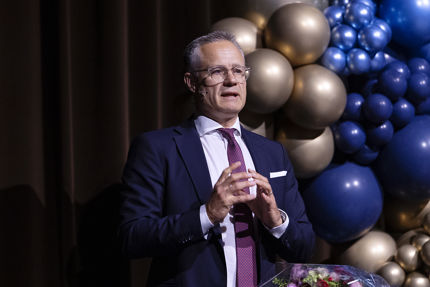
Award presenter Henrik Müller-Hansen used his speech to remind the graduates in the audience of the importance of good teachers and mentors.
'As we close this chapter today and you move on in life, I hope you will not see guiding and teaching others as something you have to do. See it as a natural part of life. Good mentors and good teachers can change people's lives,' said Müller-Hansen, adding:
'They inspire dreams and encourage us to reach further!'
He then shook Cappelen's hand and presented him with the award.
'What is your inspirational advice to other lecturers?'
'You should incorporate your own research whenever possible. It makes teaching more personal and distinctive, and it helps students see the subject as a living and relevant field,' says the award winner.
'And I also believe you should dare to show your own enthusiasm! Enthusiasm is contagious, especially when it is paired with clear academic substance.'
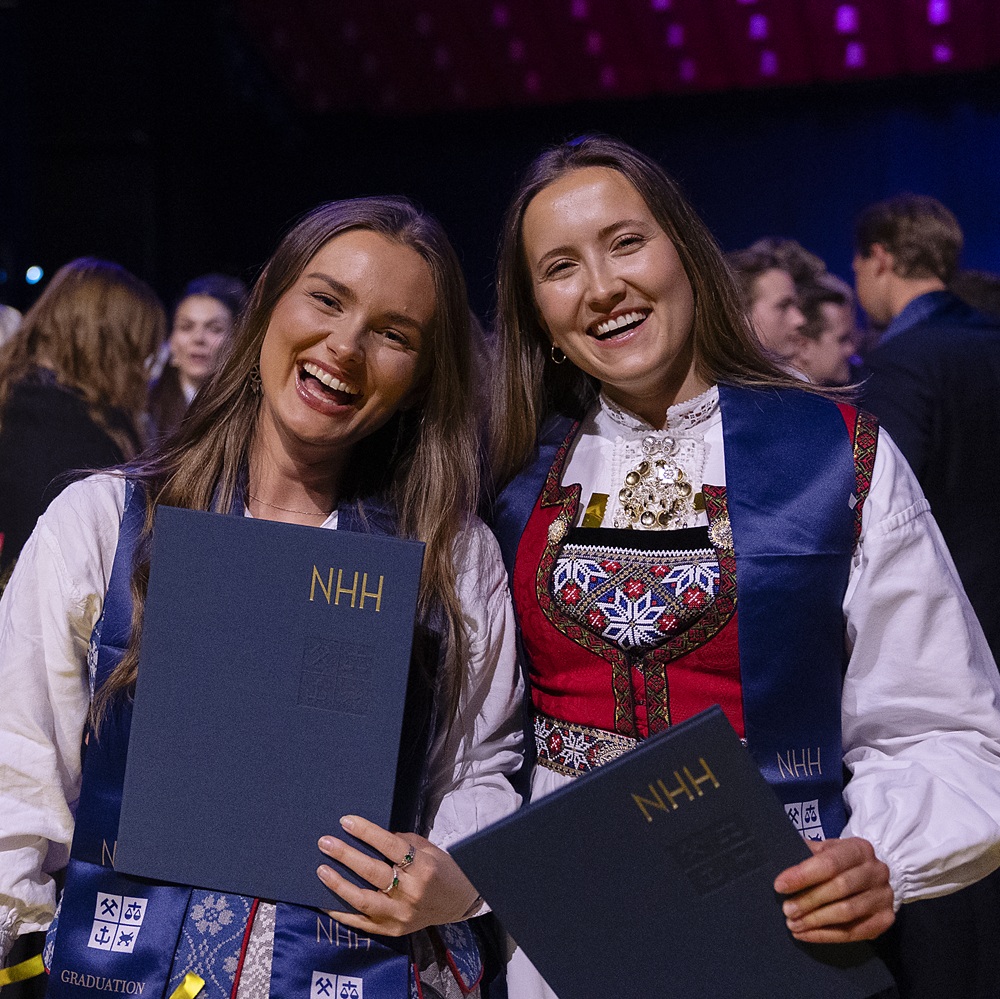
The award, worth NOK 250,000, is funded by Henrik and Isabella Müller-Hansen.
It is based on an overall assessment of teaching performance, with particular emphasis on criteria such as:
• The ability to inspire enthusiasm for the subject and its application in business and society more broadly
• Close interaction between students and lecturers
• Strong communication skills, engagement, and collaborative ability
• The ability to illuminate the subject from new perspectives
• Innovation and creativity, including the development of new courses and learning tools