Lufthansa Technik to build on NHH Students’ Solutions
‘Their solution could help aircraft use less fuel and reduce their environmental impact in the future,’ says Robin Gerlach at Lufthansa.
How do you identify the best ideas for making aviation more sustainable?
That question has occupied NHH student Anders Fosse Hereide and his fellow students over the past six months.
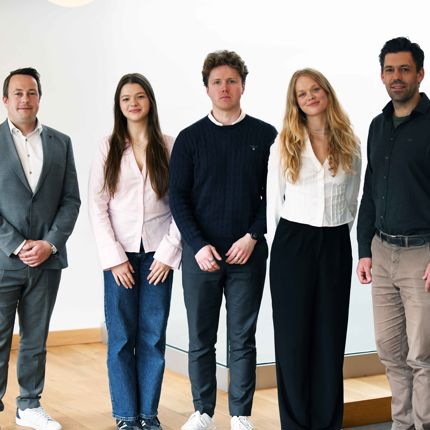
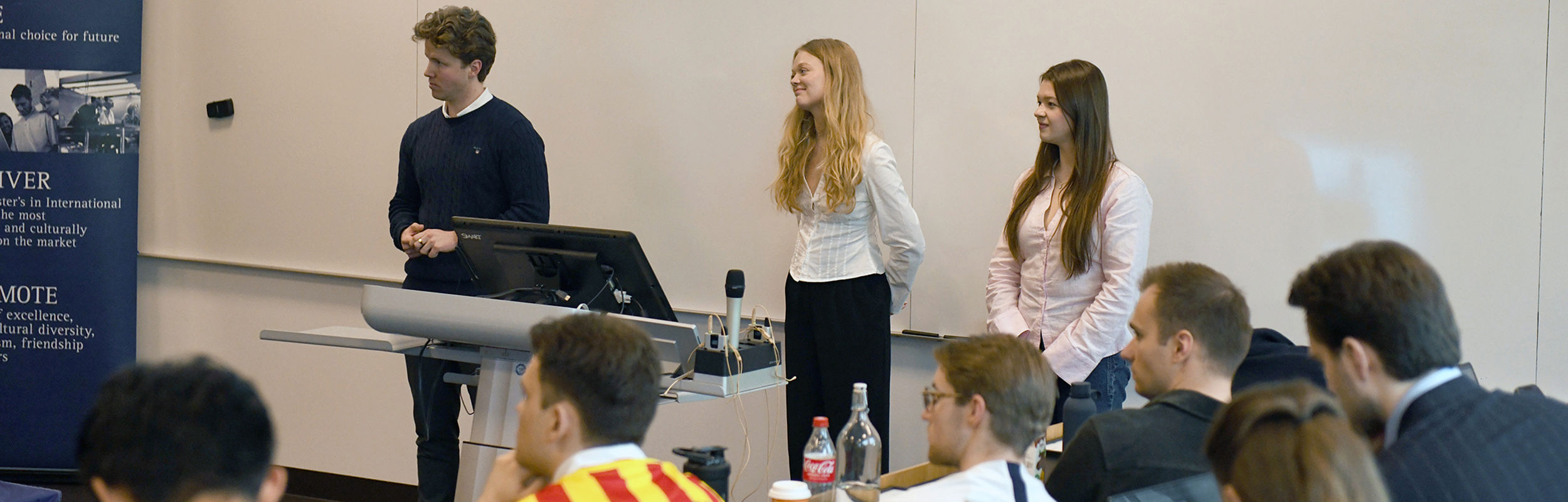
Through a CEMS Business Project for Lufthansa Technik in Germany, they developed a method for identifying and prioritizing innovations that could contribute to lower fuel consumption and reduced emissions.
‘We want airplanes to fly without harming the planet. To achieve that, we need to use as little fuel as possible, says Robin Gerlach, Manager CleanTech & Sustainable Products at Lufthansa Technik. ‘The students helped us develop a framework and a database that make it easier to identify and prioritize relevant innovation partners and solutions to this challenge,’ he adds.
Identifying the real challenge
When the students first began working on the project last winter, the task was initially focused on finding external sources for innovation. As the project progressed, however, they discovered that the main challenge lay elsewhere.
‘We quickly realized that the challenge was not necessarily generating more ideas, but establishing a structured way to identify, evaluate, and prioritize the most relevant innovation opportunities,’ says Hereide.
Over the course of the semester, the student team developed a framework that enables Lufthansa Technik to identify and assess various potential innovation partners in a more systematic way.
CEMS Business Project
- A project completed by students as part of the CEMS program.
- Student teams collaborate with a company to solve a real business challenge over the course of one semester.
- Projects conclude with a written report and a presentation to the company.
- Lufthansa Technik is one of the world’s leading providers of maintenance, repair, and technology services for the aviation industry.
- The company employs more than 20,000 people and serves airlines around the world.
- The CEMS alliance comprises 33 leading business schools from around the world and more than 70 corporate partners, including Lufthansa Technik.
For Lufthansa Technik, the project comes at an important time. The aviation industry is facing increasingly strict requirements to reduce emissions, while fuel costs continue to rise.
‘Many potential innovation partners already exist, but they are difficult to compare and prioritize systematically. We therefore need a structured way to identify which partners and opportunities are most relevant for us to pursue,’ says Gerlach.
From student project to practical application
According to Lufthansa Technik, the project results are so valuable that the company is looking at incorporating them into its ongoing operations. ‘Our goal is to turn this into a living system, not just a one-time project. We want to use these frameworks as part of our regular processes for evaluating ideas and potential innovation partners,’ says Gerlach.
For Hereide, the project provided insights that are difficult to gain through traditional classroom teaching. ‘The most important thing we learned was how innovation is actually driven within a large and established industrial company,’ he says.
‘We saw how good ideas must be balanced against practical considerations such as resources, implementation, and organizational alignment. This gave us a deeper understanding of how innovation work needs to be organized in order to create long-term value.’
Gerlach is impressed by the students’ work. ’They quickly immersed themselves in a complex field and delivered solutions that are both strategic and practical. That is exactly what we need,’ says Gerlach.