
AI Report Norway 2026: a fuller map of Norway's AI builders
Norway's AI sector keeps growing, but knowing who is actually building AI — rather than simply talking about it — has remained hard to pin down.
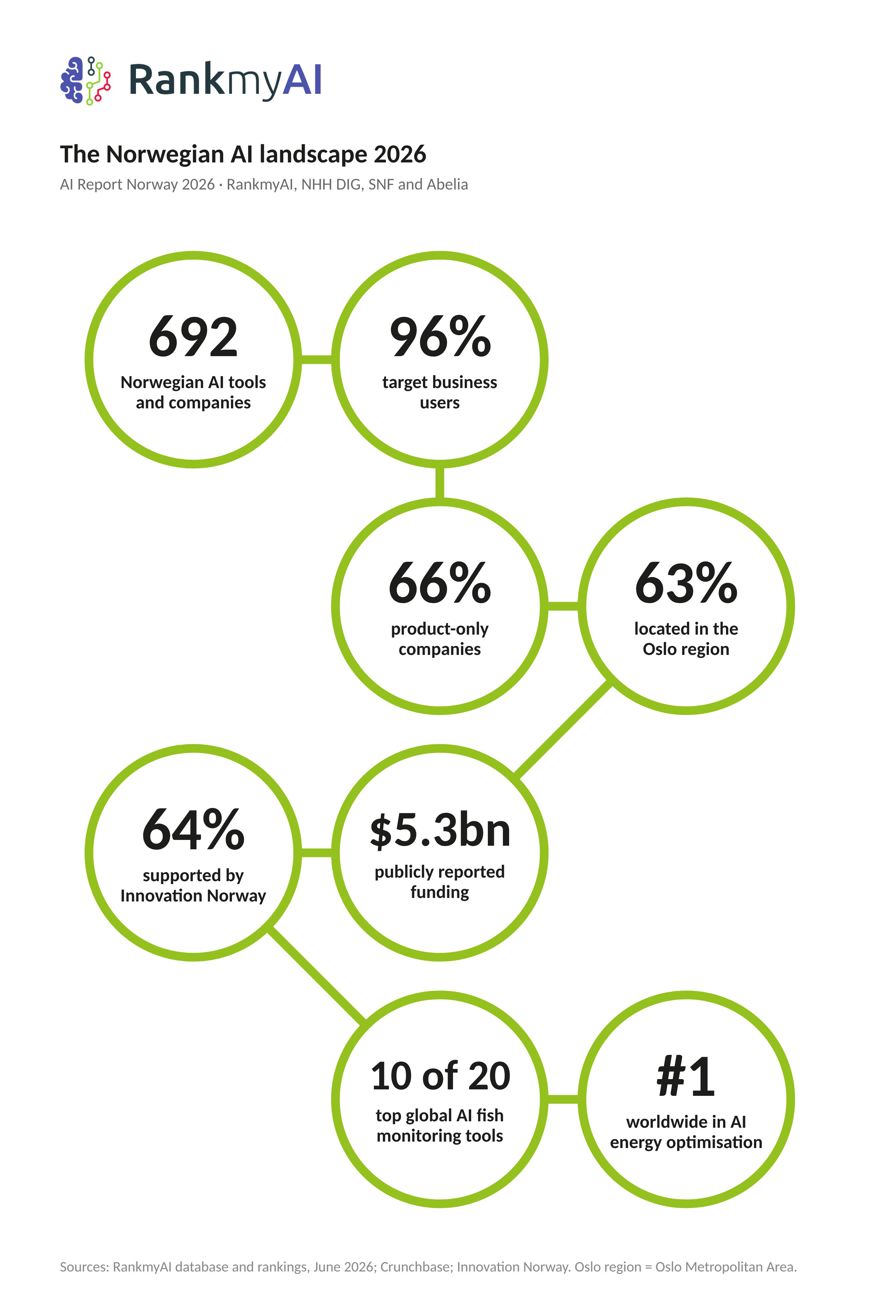
The AI Report Norway 2026 is the second, and by far the most comprehensive, data-driven overview of the companies developing AI-powered products and solutions in Norway.
The 2026 edition analyses 692 Norwegian AI tools and companies, nearly twice as many as the 2025 edition. The increase mainly reflects a more intensive search for AI tools and companies rather than a doubling of the Norwegian AI landscape itself — which means this year's picture is both broader and more representative. For the first time, the report also examines investment: publicly reported funding from Crunchbase alongside financial support from Innovation Norway.
The report is produced by RankmyAI in close cooperation with the Digital Innovation for sustainable Growth (DIG) research centre at NHH, the SNF Centre for Applied Research at NHH, and Abelia.
What's new in this edition?
- Almost twice the coverage — 692 AI tools and companies, up from 351 in the 2025 edition.
- A first look at money — USD 5.33 billion in publicly reported funding, plus USD 344 million in Innovation Norway support since 2013.
- Three years of web traffic — quarterly traffic development from 2023 to mid-2026, and the 25 fastest-growing Norwegian AI tools.
- An expanded Top 250 ranking, combining website traffic, investment, and user reviews.
Key insights
1. Norwegian AI is a business-to-business story
The single clearest characteristic of the Norwegian AI landscape is who it sells to. 96% of Norwegian AI tools and companies target professionals, developers, or organisations, against 10% targeting consumers and 7% targeting government. Two thirds (66%) sell standardised products rather than project-based services, with a further 25% combining the two — an ecosystem building scalable, exportable technology rather than only local consultancy.
This B2B orientation runs through almost every domain. Agriculture, Aquaculture & Food, Manufacturing & Industry, Logistics & Supply Chain, Data Science & Analytics, Transportation & Mobility, and AI Infrastructure consist almost entirely of tools built for business users. Consumer-facing AI appears mainly in Education & Learning, Healthcare, Media & Content Creation, and Sports & Fitness — and even there it is a minority.
2. And it builds on the industries Norway is already good at
Unsurprisingly, Norwegian AI clusters where Norway already has an established international position: the ocean economy, energy, shipping and logistics, and health. Consultancy & Tool Development is the largest single domain (14.5%), followed by Healthcare & Life Sciences (7.2%), Productivity & Collaboration (6.9%), Agriculture, Aquaculture & Food (6.1%), and Manufacturing & Industry, Energy & Utilities, and Data Science & Analytics (5.3% each). Together these seven domains account for more than half of the entire landscape.
By contrast, Norway is relatively thin in Marketing & Advertising, Customer Service & CRM, Media & Content Creation, Design & Creative Tools, and Writing & Language. The Norwegian profile is one of applied AI for established industries — prediction, optimisation, analytics, and operational support — rather than consumer-facing generative AI. AI is being layered onto existing industrial strength, not built in isolation from it.
3. Where Norway is relatively strongest
Compared with France, Germany, the United Kingdom, Denmark, and the Netherlands, Norway's distinctive AI specialisations are Energy & Utilities, Agriculture, Aquaculture & Food, and Real Estate — each accounting for a higher share of Norway's AI landscape than of the comparison countries'.
In two of these areas, Norwegian companies do not just specialise — they lead globally:
AI fish monitoring — 10 of the world's top 20 tools are Norwegian. In RankmyAI's global ranking (June 2026), Norway holds the number one position and half of the top twenty: Aquabyte (#1), Biosort (#3), AKVA group (#5), OptoScale (#6), Stingray (#7), Imenco Aqua (#11), Createview (#12), SeaSmart (#18), Manolin (#19), and Fishency Innovation (#20). No other country comes close in this domain.
AI energy optimisation — 4 of the global top 20, including the world number one. Tibber ranks first globally, followed by Arundo Analytics (#9), Veyt (#19), and Kiona (#20).
These are textbook cases of entrepreneurial co-invention: companies emerging either from the aquaculture and energy industries and adding AI (Spillfree), or from AI and moving into those industries (Aquabyte). Norway's competitive advantage lies less in generic, multi-purpose AI technology than in adapting AI to demanding domain problems and integrating it with existing physical assets, data, and industrial know-how.
Beyond these two niches, Norway's most prominent AI companies overall include AutoStore (warehouse robotics), Xeneta (freight rate benchmarking), 24SevenOffice, Ardoq, Signicat, Attensi, Keystone Education Group, Boost AI, and eSmart Systems — again, overwhelmingly B2B, and overwhelmingly in sectors where Norway has a long-standing industrial or institutional base.
4. A young landscape, built on an older base
Around 41% of Norwegian AI tools and companies are less than five years old, and 48% were founded in 2020 or later. The peak year was 2023 (11.5% of all companies). At the same time, a smaller group of much older firms — some founded decades ago and since expanded into AI — pulls the average age up to 9.5 years, among the oldest of the European countries compared. The oldest domains are Finance & Insurance (15.3 years) and Manufacturing & Industry (14.9 years); the youngest are Real Estate (5.4) and Security & Surveillance (6.3).
5. Oslo remains the centre of gravity
Oslo accounts for 48.6% of all Norwegian AI tools and companies, followed by Trondheim (6.7%), Bergen (5.5%), and Stavanger (5.1%). Widening the lens to the Oslo Metropolitan Area — including Bærum, Asker, Lillestrøm, Drammen, and others — raises the share to 63.2%. Five regions host more than 80% of the entire Norwegian AI landscape.
6. Funding is real, but highly concentrated
Publicly reported funding for Norwegian AI companies totals approximately USD 5.33 billion — but more than half of that (USD 2.8 billion) belongs to AutoStore alone. Excluding AutoStore, Oslo accounts for 73.7% of remaining funding, and Productivity & Collaboration becomes the largest funded domain (29.8%), ahead of Energy & Utilities (15.8%) and Finance & Insurance (11.1%). The median funded company has raised USD 2.5 million — more than in Denmark (2.3) and the Netherlands (2.1), but well behind Germany (5.5), France (4.7), and the UK (3.6).
Public support tells a different and broader story: Innovation Norway has supported 440 of the 692 companies (64%), with USD 344.3 million between 2013 and June 2026. AI's share of Innovation Norway's total funding rose from 0.4% in 2013 to 6.2% in 2025. In other words, public-sector support reaches far more of the ecosystem than publicly reported investment rounds suggest — and it flows disproportionately to Energy & Utilities, Healthcare & Life Sciences, Manufacturing & Industry, and Agriculture, Aquaculture & Food: the same industrial strengths again.
7. Growing online attention — captured by a few
Quarterly website traffic to Norwegian AI tools rose from roughly 47 million visits in Q3 2023 to over 60 million in Q2 2026, an increase of almost 30%. Between July 2025 and June 2026, 430 Norwegian AI tools grew their traffic while 168 declined, and several grew by more than 1,000%. Yet attention stays concentrated: the five most visited tools account for 50% of all traffic, and the top 25 for 78%.
Reference: Weltevreden, J.W.J., & Timmermans, B. (2026). AI Report Norway 2026. Amsterdam: RankmyAI / Amsterdam University of Applied Sciences.