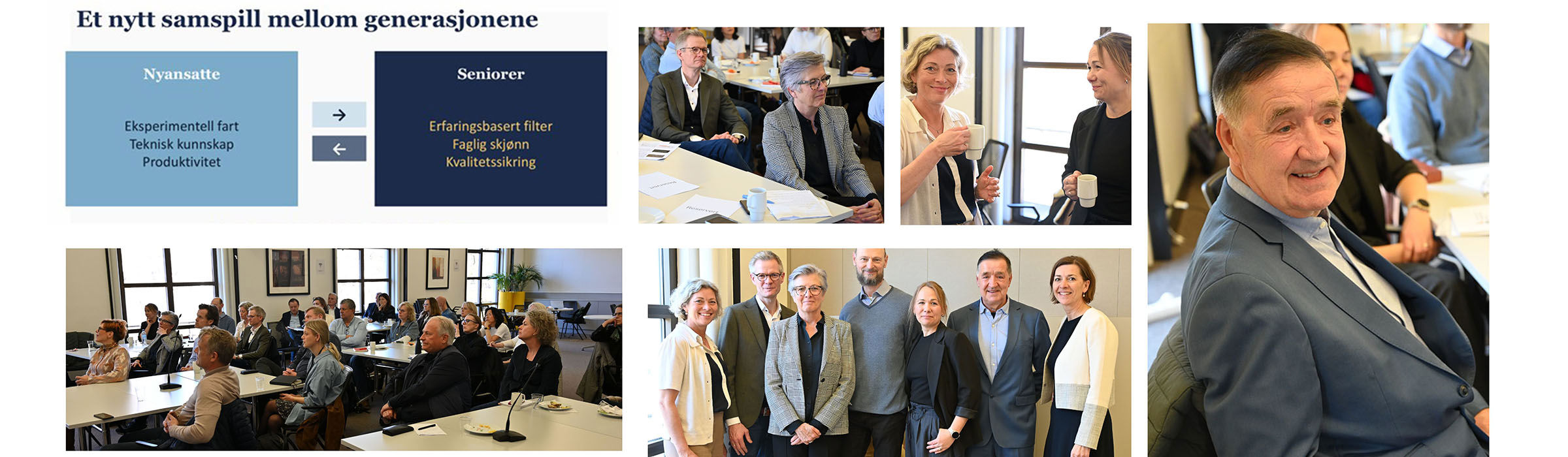
From the DIG event on seniors and AI. Clockwise, top: Gunnar Inderberg, Kari Østerud, Therese Egeland, Nina Myklebust, Jan Storehaug (right), the panel of contributors including Rolf Røtnes of "Samfunnsøkonomisk analyse" (centre) flanked by the two professors Therese Egeland (left) og Inger Stensaker (right). The audience btm left. All photos: Arent Kragh
While newcomers to working life use AI to increase speed and take on more tasks, seniors use AI for relief and as a sparring partner.
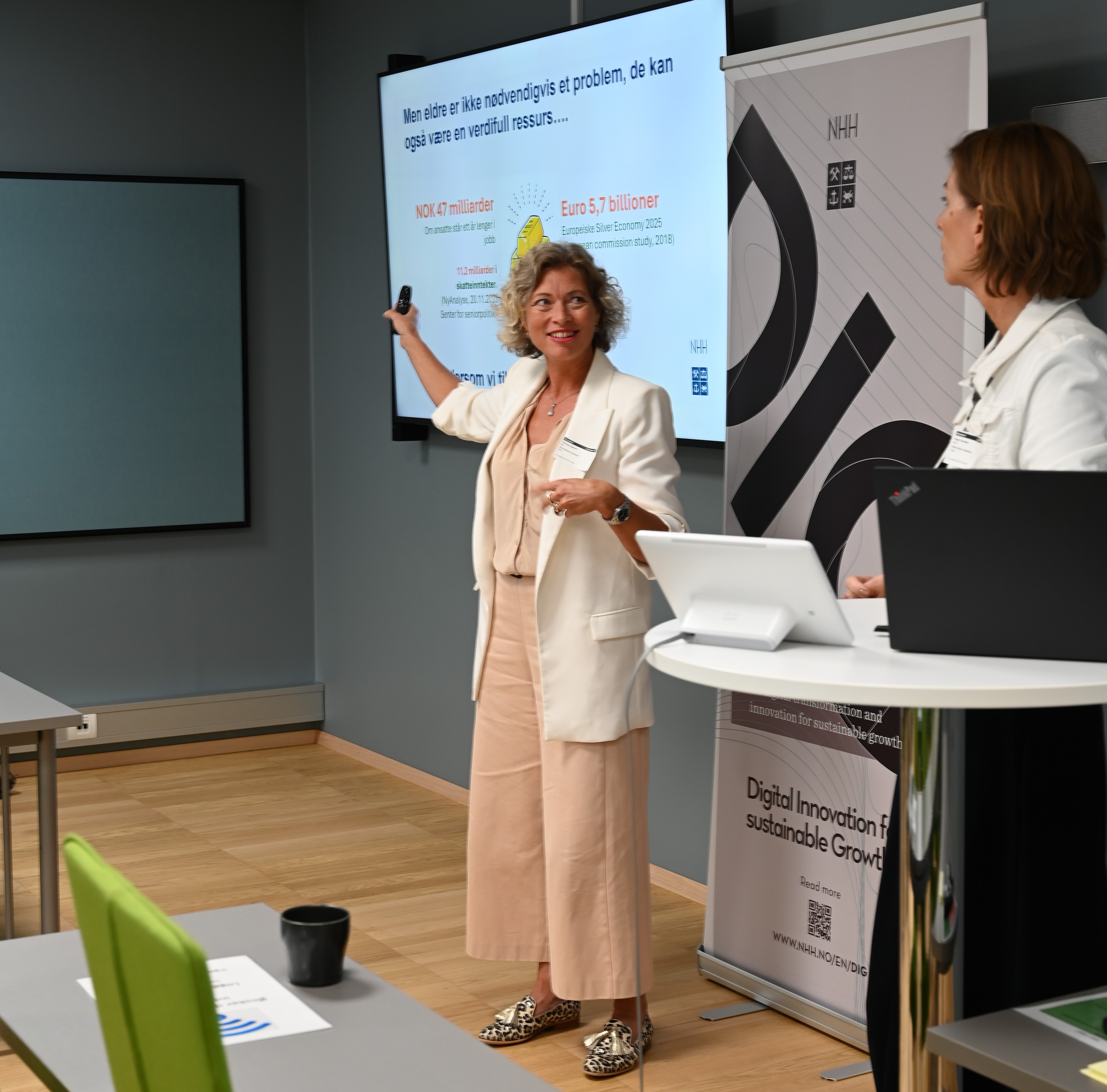
This week, the research center DIG and NHH professors Therese Egeland and Inger Stensaker invited participants to a panel debate and workshop on the opportunities and potential in the interplay between AI and demographic change. The event is part of the research project “The silver economy,” which the two lead.
Older and younger workers must collaborate
The audience gained insight into a new master’s thesis from NHH.
The claim that young people are born digital and that seniors lag behind is among the most widespread narratives about artificial intelligence in Norwegian working life. The master’s study suggests that this narrative is wrong—and that the consequences of believing it are costly.
The findings were supported by serial entrepreneur and CEO of Tenk Digitalt AS, Jan Storehaug (60).
– AI makes those of us with good judgment more valuable as workers. Put the younger and older employee together, with AI in between. That’s dynamite, he stated.
Therese Egeland, professor at the Department of Strategy and Management, pointed to the need for organizations to assemble teams across age groups, with AI as an important tool in the work.
– New hires experiment. They have technical knowledge and maintain high output using AI. Seniors have an experience-based filter, strong professional judgment, and quality assurance. Put them together in teams, was one of her recommendations, based on their findings.
– It’s not those with the lowest age who succeed with AI, but those with the right role, Egeland said.
Organizations that treat AI as a generational problem miss the real picture, and probably the potential, Therese Egeland concluded.
Misleading associations and prejudice
Kari Østerud is Director at the Knowledge Centre for a Longer Working Life. She moderated the panel discussion after the research findings were presented.
– Set aside the association with health and care costs when you hear about older people and seniors, was her takeaway.
Nina Myklebust from the Centre for an Age-friendly Norway agreed:
– We can’t just keep recruiting 30-year-olds. We’re going to run out of 30-year-olds. Working life must use resources in a better way than we do today.
A diverse workforce that understands different customer segments and avoids age discrimination is Myklebust’s recipe for how business can leverage the opportunity in the “silver economy.”
– Age discrimination is the only socially accepted form of discrimination, she argued, while also reminding the audience that seniors are the customer group growing the fastest.
The aging population is often framed as a looming burden—on welfare systems, healthcare, and productivity. Yet this perspective captures only half the story. The same demographic shift is also creating one of the largest and least exploited economic opportunities of our time: the Silver Economy.
Making everyday life easier and the world smaller
Norway’s oldest existing company, Posten, established in 1647, shows that even in an increasingly digital everyday life, the in-person, analog interaction still has great value. Through its “Doorstep Project”, it is testing the effect of ensuring that all residents over 75 in eight municipalities, once a week, not only receive mail and parcels delivered to their mailbox, but also meet the postal worker who rings the doorbell. They are handed their mail along with an information sheet from the municipality about relevant activities and offers for the target group in the coming week.
– A very simple service, but it works. Eighty to ninety percent read the municipality’s information sheet, and about forty percent take part in an activity mentioned in it. This can delay the need for care services. We make everyday life easier, and the world smaller, says Gunnar Inderberg, Director of Operational Development at Posten Norge AS.
The Norwegian society is in the midst of a demographic shift, accentuating the need for knowledge on how to extend careers and create new business opportunities.