I have always been interested in the gap between innovation and business success, and in how firms can bridge that gap.
Jialei Yang
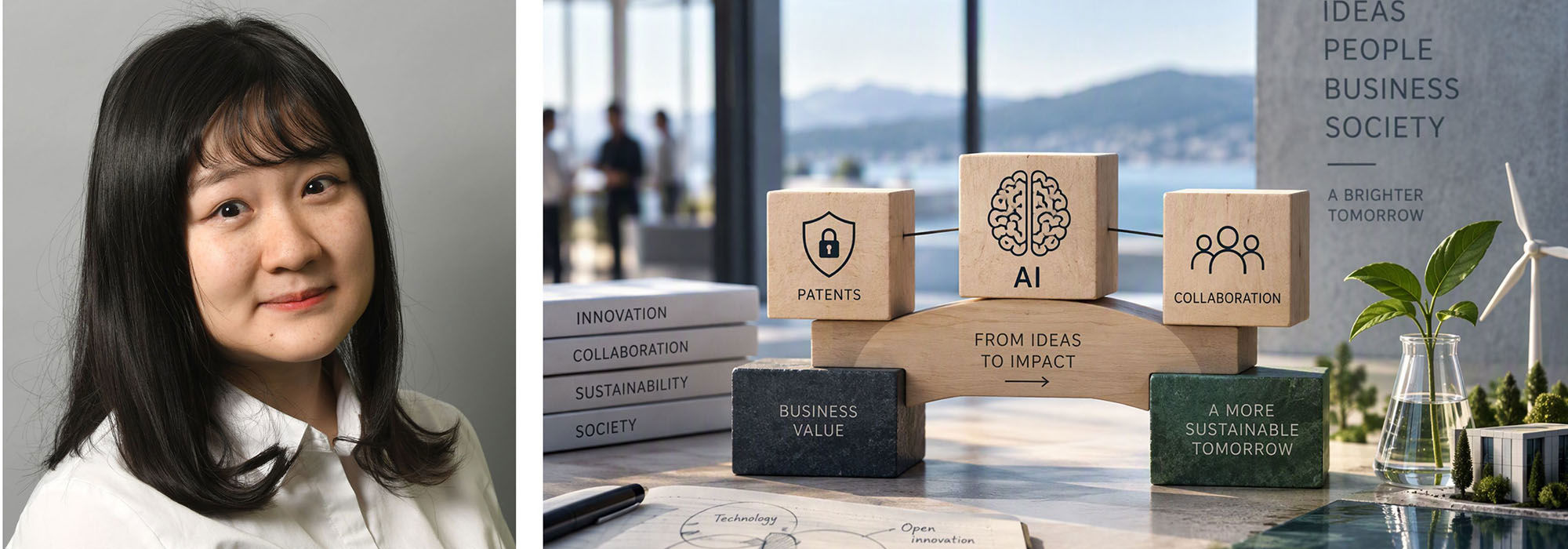
As technology continues to evolve, Associate Professor Jialei Yang investigates what it takes for companies to succeed in an increasingly complex innovation landscape.
For Associate Professor Jialei Yang, an important question is why some companies succeed in turning innovation into business value, while others struggle, even when they have developed and protected new technologies.
I have always been interested in the gap between innovation and business success, and in how firms can bridge that gap.
Jialei Yang
Yang is an Associate Professor at NHH and is affiliated with DIG. Her research focuses on how companies manage innovation, collaborate with others, and benefit from the ideas and technologies they develop.
“I have always been interested in the gap between innovation and business success, and in how firms can bridge that gap,” she explains.
Yang holds a PhD from the University of Oulu in Finland and has spent time at both UC Berkeley and Stanford University. These experiences helped shape her interest in innovation research and entrepreneurship, particularly how companies manage innovation and turn new ideas into commercial value.
A central question in Yang's research is why companies sometimes struggle to benefit from their innovations, even when they have invested heavily in protecting them. Many companies, particularly larger ones, build extensive patent portfolios to protect their ideas. However, Yang points out that these patents often remain unused and do not necessarily contribute to business success.
Her research therefore challenges what she describes as a “patent-first, decide-later” approach. Instead, she suggests that companies should actively consider how intellectual property protection and collaboration can support their broader innovation strategies. This becomes particularly relevant when companies shift between open and closed innovation strategies. Yang highlights how Google's Android has moved certain applications towards closed-source solutions, while Nokia's attempt to open-source Symbian was unsuccessful.
These examples have made her particularly interested in how companies strategically manage knowledge and innovation, and how they can balance protecting their ideas with collaborating with others.
“Having strong appropriability, for example through patents or other intellectual property rights, doesn't necessarily conflict with open innovation,” she explains.
More recently, Yang has also been exploring how companies can use innovation to create positive impacts on society and the environment. While businesses often focus on reducing the negative consequences of their activities and meeting regulatory requirements, some go further by actively seeking to address environmental and societal challenges. Yang refers to these companies as impact innovators.
One example that has shaped her thinking comes from her research on Intel, where she studied how the company's dependence on water in semiconductor manufacturing could be turned from a resource-related challenge into a competitive advantage. This has also led her to reflect on similar challenges emerging with artificial intelligence, where the growing demand for data centres places increasing pressure on natural resources.
“While we usually place emphasis on innovation itself, we should also think about natural resources associated with producing that innovation,” Yang says.
As part of this research, she has developed a method called Automated Stakeholder-Impact Mapping via Large Language Models, which uses AI to analyse textual data and explore how companies understand their impacts and engage with different stakeholders.
Looking ahead, Yang is particularly interested in how artificial intelligence is changing the way companies innovate, collaborate, and create value. She hopes to explore how AI innovators and companies applying AI technologies can capture value from innovation, as well as how businesses can manage open innovation and partnerships in an increasingly AI-driven economy.
For Yang, these questions are closely connected to her broader research interests. As AI creates new opportunities for businesses, it also brings new challenges related to resource use and societal impact. Understanding how companies navigate both sides of innovation is something she hopes to explore further.