From competing better to competing differently
Many companies do not fail because their products are poor. They struggle because too many competitors are using the same business model to serve the same customers in the same way.
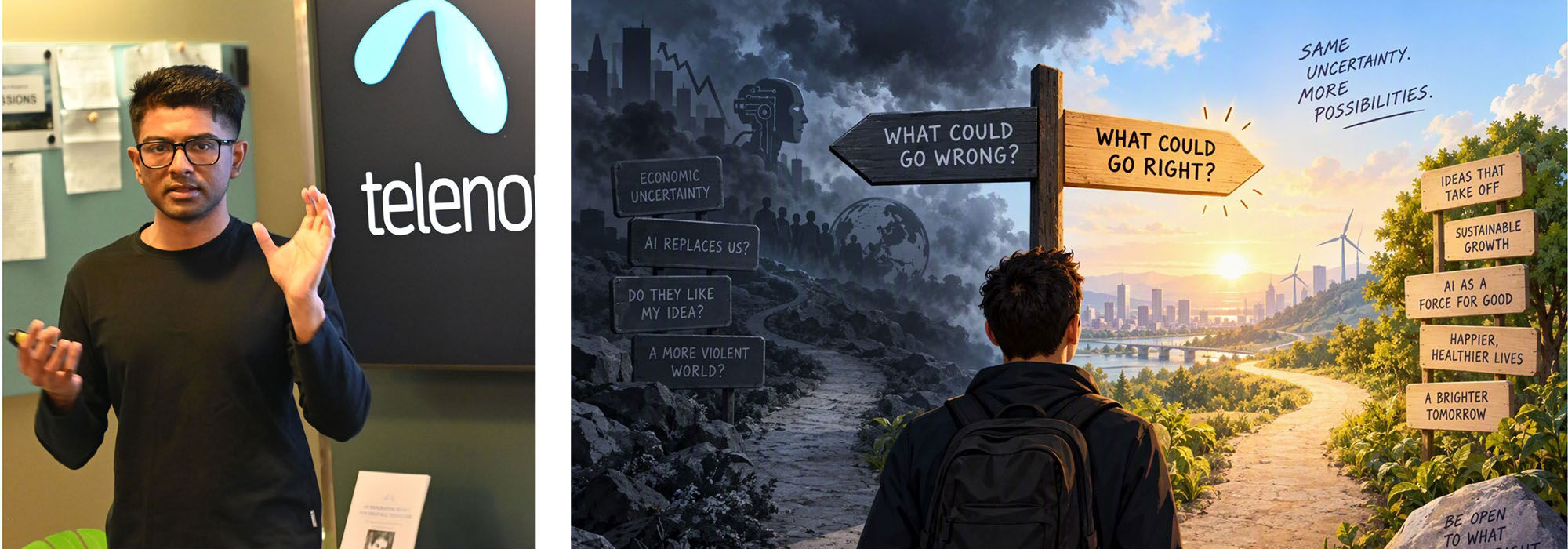
We have never had so much information at our fingertips, yet things around us feel uncertain. Do my colleagues like my proposal? Are we in a bubble? Will artificial intelligence replace us?
While there are good reasons to worry about these, I’d like to make the case for being open to what could go right. Of course, I cannot predict what exactly could go right; that’s for each of us to consider.
When things are risky and uncertain, it is human nature to be concerned. Losses hurt more than gains 1, bad is stronger than good 2. And this has served us well evolutionarily because ignoring the snake in the bushes had a greater impact on survival than getting false scares. While there are fewer snakes around these days, there are other things that threaten us.
The markets, politics, and society are changing increasingly fast. And where things are heading is becoming harder to extrapolate from what we know. So, it makes sense to worry about all the ways things can go wrong - for our career, social life, or humanity in general. But it might also be worth considering how some of the things that matter might go our way.
I first heard the phrase what could go right on Scott Galloway’s Prof G podcast. I find this powerful because it is different from general optimism that things will go right, and rather focuses on what could go right in a particular context. Maybe your colleagues will love the idea you have been going back and forth on for months; maybe the economy will keep growing, with enough innovations to grow sustainably; maybe the role of artificial intelligence in our lives will stabilize as a net positive. Speaking of, if AI frees up time in our teams, how much have we thought about what we would like people to do with that time?
To be sure, with all that’s in the news these days, considering what could go right might seem like a luxury. But a lot of research reveals that things are not as bad as we think. For example, the famous prediction that population growth will lead to mass starvation didn’t actualize 3. In ongoing work on 160 countries over two decades, about 60% of countries grew both their economy and their happiness at the same time. While today’s news coverage makes the world feel more violent than ever, actual physical violence has massively decline across human history 4. Society has not become less moral over time 5, and in my own research, people vastly overestimate the dishonesty of others, which can decrease trust and increase surveillance 6. In my work on climate action, simply giving people accurate information about impact increased their support for the more effective behaviors over less effective behaviors 7.
So, where does all this lead us? I suggest we spend as much time making plans about what our next steps would be if things go our way, as we do contingencies for negative developments. For a firm, that could mean having a plan for scaling up if a new product takes off, not just a plan for cutting losses if it flops. We can’t read others’ minds or see into the future, but the universe doesn’t conspire against us. While we cannot say for sure, the first humans spreading across continents perhaps considered what could go right in treacherous waters. The Wright brothers, with their limited resources, gambled that humanity could chart the skies, and then Neil Armstrong landed us on the moon. Modern medicine helps us live longer, technology lets us connect across oceans, and quality of life is high for more people now. None would have happened if people had planned only for what could go wrong.
Back on earth, as a consumer psychology Principal Investigator at DIG, I am amazed by human experience, condition, and potential. Yes, life is often unpredictable, we have our flaws, and there are challenges ahead. But if things go right, are we prepared to make the most of opportunities? I shall end this piece with some thoughts that I remind myself of in the best of times and the worst of times, across work life and social life.
Here goes:
· Things have been, are, and always will be uncertain. What do we really need to know before we can act? Are we delaying things because of actual necessity, or just the concern of things going wrong?
· Life is surprisingly a mix of rule-based outcomes and luck, like poker. Given the cards we have been dealt, what is the best move? Because with limited resources, we might as well focus on things we can do.
· We don’t need to win at everything and all the time. Winning 60% of the time might suffice, and maybe taking the shot when we are 80% sure can lead to success.
· Finally, while we will get the urge to fear the unknown, we might also want to consider what could go right, so we are ready to make the most of the opportunities the universe might provide us with.
Jareef Martuza is a tenure-track Assistant Professor in Marketing and Principal Investigator at the DIG Research Centre. His research on whom people are more likely to cheat, how accurate our beliefs are, and how we think about time has been published in the Journal of Experimental Social Psychology, Personality and Social Psychology Bulletin, and Nature Human Behaviour, and covered by popular media outlets like The Times UK, BBC 5 Live, The Economic Times, and New Scientist. Projects: jareef.com/research.