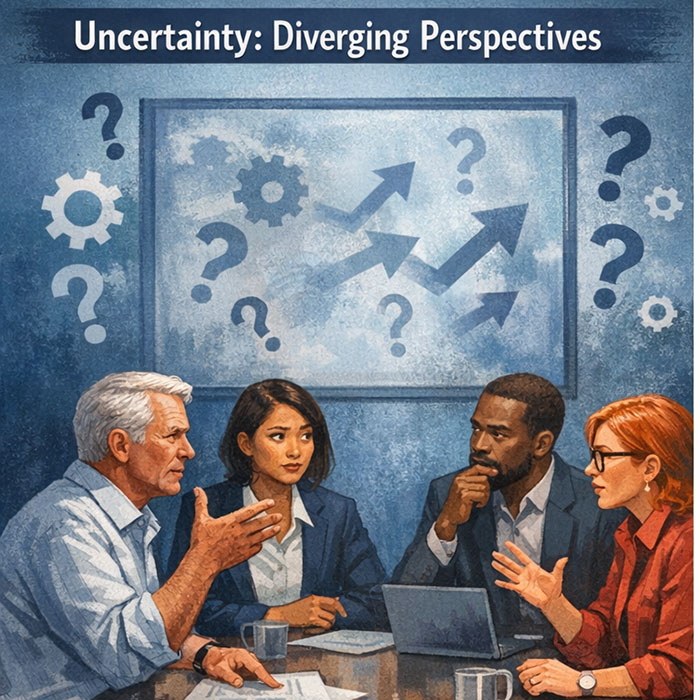
Karen Modesta Olsen (et al) have recently published research into AI in recruitment - and some illustrations of what AI thinks that could look like. (Photo: NHH and AI)
Artificial intelligence is already changing recruitment, particularly through tools that support automated screening and candidate matching. AI can make recruitment faster, more systematic, and potentially more objective, but responsible use requires strong human involvement.
Large language models are reducing the value of traditional application letters, while CVs and LinkedIn profiles are becoming more important. The authors argue that AI should be used as decision support rather than as a replacement for recruiters. For HR professionals and consultants, the central implication is clear: AI in recruitment must be governed carefully, combined with HR expertise, and implemented in ways that preserve fairness, inclusion and human judgement.
AI is best understood as decision support - but humans should remain accountable for decisions, and be "in-the-loop".
Key findings and insights
1. AI is mainly changing the early stages of recruitment
The clearest current role for AI is in the first stages of recruitment: screening, filtering, sorting and matching candidates. These are areas where large volumes of data need to be processed and where AI can help create more efficient workflows. For practitioners, this suggests that AI is most useful where the task is structured, repeatable and data-rich.
2. The application letter is losing some of its value
The article points out that the spread of large language models has reduced the traditional informational value of application letters. When candidates can generate strong written applications with the help of AI tools, the application letter becomes less reliable as a signal of communication ability, motivation or fit.
As a result, CVs and LinkedIn profiles are becoming more important sources of information. This has practical consequences for recruitment design. Organisations may need to rely more on structured CV data, verified experience, work samples, structured interviews or targeted questions that are harder to outsource to generative AI.
3. AI may reduce some forms of bias, but can also reproduce bias
The article recognises that AI can help make recruitment more consistent and potentially more objective. By applying the same criteria across candidates, AI-supported tools may reduce some forms of human inconsistency and unconscious bias.
At the same time, the article stresses that AI does not automatically produce fair or inclusive outcomes. Algorithms reflect design choices, training data and optimisation goals. If these are not carefully managed, AI tools can reproduce or even reinforce existing biases. Responsible use therefore requires active attention to inclusion, transparency and governance.
4. AI is best understood as decision support
The informants in the study are described as broadly positive towards AI as a support tool. This is an important distinction. AI can help recruiters structure information, identify relevant candidates and improve process efficiency, but it should not be treated as a substitute for professional judgement.
For HR teams, this implies a “human-in-the-loop” approach. Humans should define the criteria, understand the tool’s limitations, interpret the results and remain accountable for decisions. This is especially important in recruitment because hiring decisions affect people’s careers and the legitimacy of the employer.
5. Interviews and final assessments should remain human-led
The article emphasises that personal interviews should still be handled by humans. Recruitment involves social, relational and contextual judgement. Motivation, interpersonal skills, communication style, potential and cultural contribution are difficult to reduce to data points. These dimensions remain central to good hiring decisions.
This does not mean that AI has no role in later stages. AI may support interview preparation, structure competency frameworks or summarise information. But the relational and evaluative core of the interview should remain human-led.
Implications for HR departments in larger corporations
For larger corporations, the article suggests that AI should be introduced through clear governance rather than ad hoc experimentation. HR should define where AI may be used, what data the tools rely on, which decisions remain human-led, and how outcomes will be monitored.
The most promising use cases are likely to be in early-stage screening, candidate matching and process support. However, organisations should avoid allowing efficiency gains to override fairness, transparency and candidate experience.
Corporations should also revisit the design of their recruitment processes. If application letters are becoming less informative, HR teams may need to strengthen other assessment methods, such as structured interviews, case-based tasks, work samples and clearer competency criteria.
In recent years, servant leadership has become one of the most celebrated leadership styles in business. Leaders who prioritize employee development, support, and empowerment are often assumed to produce both happier teams and better results.
Implications for consultants and advisors
For consultants advising clients on AI in recruitment, the article provides a useful framing: the key question is not simply whether to use AI, but how to combine AI with HR expertise in a responsible and effective way.
Consultants can add value by helping clients map the recruitment process, identify suitable points for AI support, assess bias and inclusion risks, define accountability, and design human-in-the-loop processes. They can also help clients ask practical governance questions before implementation: What criteria are being optimised? Which candidates may be disadvantaged? How will outcomes be monitored? How will candidates be informed about the use of AI?
The article’s emphasis on the interaction between technological competence and HR competence is especially relevant for advisory work. Successful implementation requires both technical understanding and deep recruitment expertise.
Practical takeaways
Use AI primarily where it is strongest: early-stage screening, sorting and matching of candidates.
Treat AI as decision support, not as an autonomous hiring authority.
Review the role of application letters, since generative AI has made them less reliable as assessment material.
Keep interviews and final assessments human-led.
Build governance around fairness, transparency, accountability and inclusion.
Combine HR expertise with technological competence when implementing AI tools.
Monitor recruitment outcomes continuously to detect unintended bias or exclusion.