I believe people censor themselves less than in surveys.
Rector Helge Thorbjørnsen
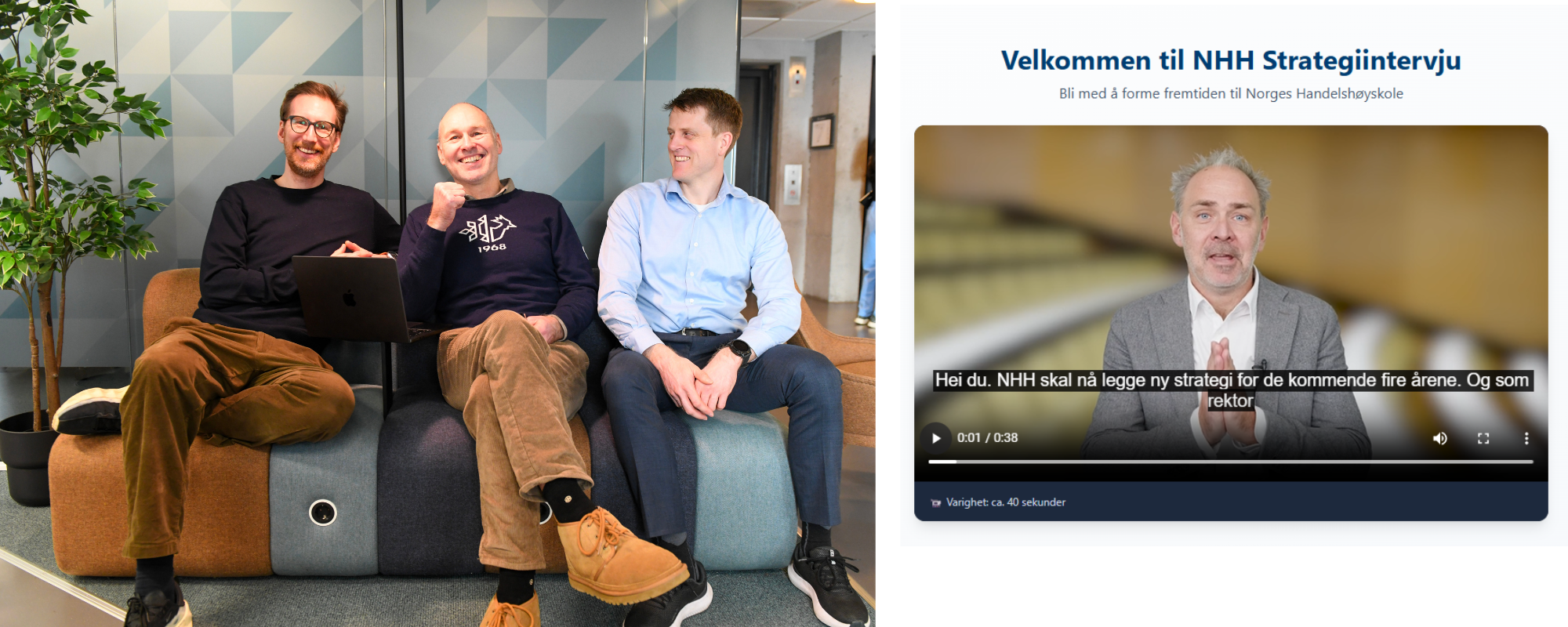
NHH let an artificial intelligence, disguised as the rector, conduct strategic interviews. Now, others want to adopt the professors’ method.
Over the course of a few weeks this autumn, more than 800 students, employees, alumni and partners of NHH took part in digital one‑to‑one conversations with an AI‑powered interview bot – camouflaged as Rector Helge Thorbjørnsen.
The result was the most comprehensive stakeholder analysis in the school’s history, and a completely new way of working with strategy.
The initiative came from Rector Helge Thorbjørnsen himself. As work on the new strategic plan for 2026–2029 began, the experiment‑minded rector wanted to take a different approach. A traditional strategy process often involves external consultants, complex templates and standardized surveys.
'But we have strong expertise in strategy here at NHH. At the same time, artificial intelligence offers enormous opportunities to collect data and decision support. This is exactly what we teach our students. So it made sense to practice what we preach,' says Thorbjørnsen.

From the first discussions about possibilities to a fully tested AI solution, the process took three intense weeks. In October, a link was sent out to participants.
The structured interviews were designed to last 10–15 minutes. Unlike traditional surveys, these were real conversations, with follow‑up questions, clarifications and guidance along the way.
The bot moved through different interview phases depending on whether it spoke with students, employees, alumni or partner organizations. It allowed room for longer reasoning, while also steering conversations back on track when needed.
Knudsen and Lundervold, who have analysed all the conversations, say the longest interviews lasted close to 45 minutes.
'Several participants told us they found it both fun and meaningful', says Lundervold.
'This represents a completely different way of communicating with artificial intelligence', adds Sjåholm Knudsen.
'People are used to asking ChatGPT questions and getting long answers back. Here, it’s the AI asking you questions. The design creates a ping pong dynamic that produces much higher quality input than a standard survey', Knudsen explains.
NHH has already received inquiries from other organizations – including large enterprises – interested in using the same method.

Professor of strategy Lasse B. Lien highlights two key advantages of the method, in addition to the improved data foundation:
AI has also been used to produce environmental and competitor analyses, based on existing sources and reports.
I believe people censor themselves less than in surveys.
Rector Helge Thorbjørnsen
And the material is not static.
He particularly highlights one major benefit:
'It also creates greater legitimacy and buy in when everyone has had a chance to contribute.'
The large volume of data will now be important not only for the strategic plan, but also for follow‑up action plans and implementation.