Prize-Winning Master’s Thesis Sheds New Light on Offshore Wind Strategy
The work of NHH students Julius Ahrens and Luis Bendel reveals a striking finding.
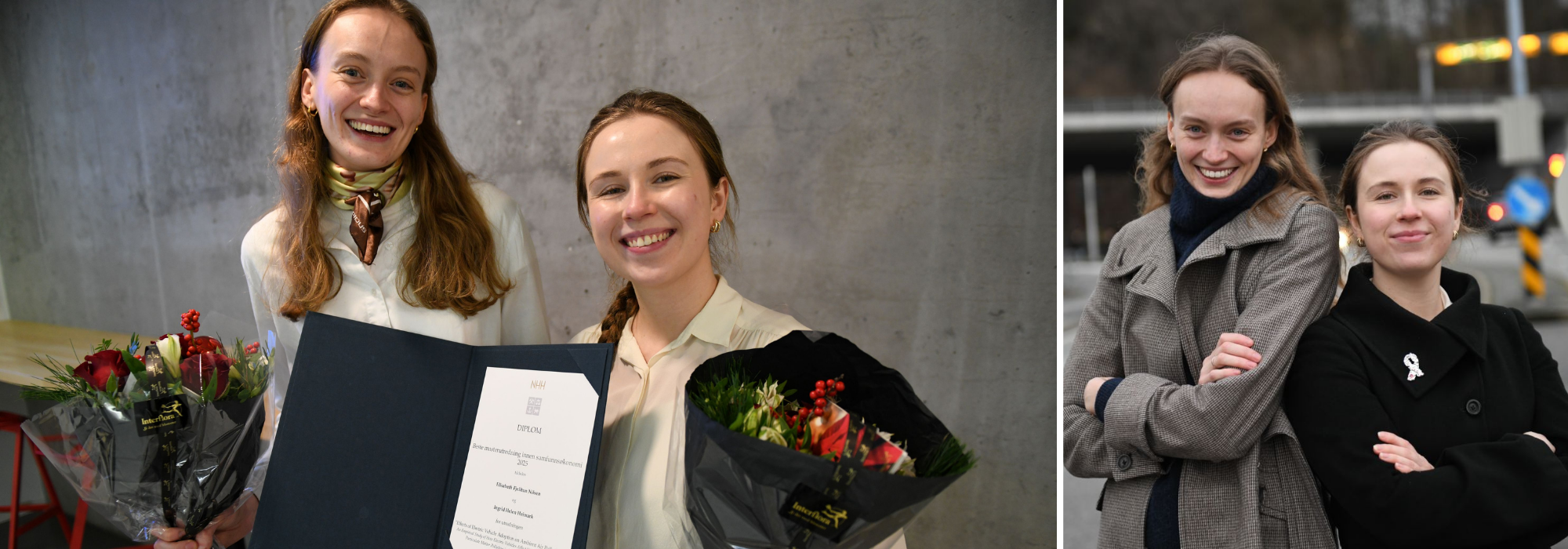
Delighted NHH students Elisabeth Fjelltun Nilsen and Ingrid Helen Heimark score a prize for their masters thesis on how electric vehicles affect air quality.
«It’s very rewarding to receive recognition for something we’ve worked so hard on,» say Nilsen and Heimark, surrounded by a friendly chaos of flowers, hugs, and diplomas.
On Tuesday, they received clear confirmation that they had won the award for Best Master’s Thesis at the Department of Economics.
Then it was straight out into traffic—because that’s where they truly made their mark.
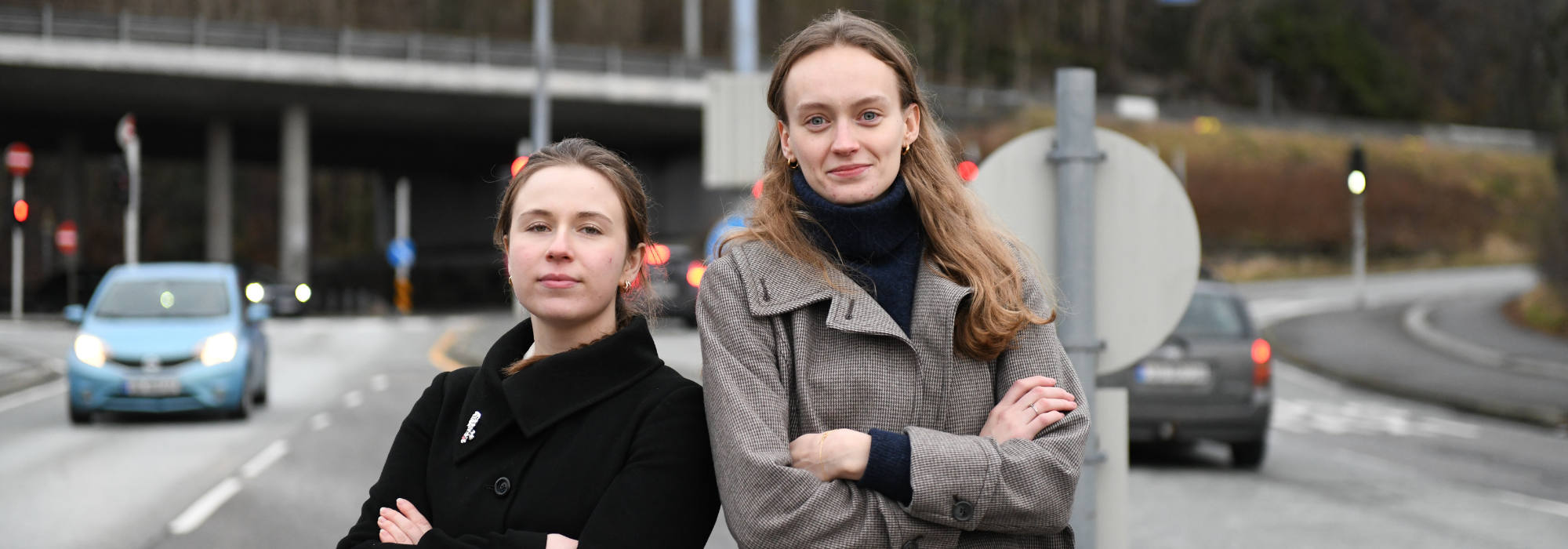
Most people who drive electric cars feel a bit better and greener than those who drive fossil-fuel vehicles. They know they have made an environmentally friendly choice, but beyond that: what do they actually contribute while sitting behind the wheel of their battery-powered cars?
Quite a lot, according to the master’s thesis by NHH students Nilsen and Heimark.
By collecting and analyzing ten years of data on air quality, the number of electric vehicles, traffic patterns, and charging infrastructure, they show that the electric car boom has led to significantly cleaner urban air. The effect is particularly strong for the harmful gas nitrogen dioxide (NO₂).
During the period 2010–2019, which their data cover, the share of electric vehicles in the analyzed sample increased by 12 percentage points. Over the same period, NO₂ levels were reduced by around 50 percent.
The emissions reductions correspond to 272 lives saved, in the sense of avoided premature deaths. According to the thesis, the total social benefit is estimated at NOK 2.2 billion.
«In economics, we focus on causal relationships—that is, being confident that one thing actually causes another. It’s very satisfying when the results are concrete and have practical value,» say the award winners.
So, is the electric car boom an unbroken success story for the environment? Short answer: no.
Electric cars solve only part of the air pollution problem, as particulate matter still lingers heavily over the asphalt in many places.
«Our analyses show that a higher share of electric vehicles neither increases nor reduces particulate matter levels,» says Nilsen.
Unlike NO₂, particulate matter does not come solely from exhaust emissions.
So-called PM₁₀ and PM₂.₅ particles can originate from road and tire wear, sand and gravel used in road maintenance, dust from construction sites or nearby industry, or—as in parts of Oslo—extensive sauna activity along the fjord combined with wood burning. Local geography can also play a role.
«This is something that should be investigated further,» Nilsen recommends.

According to the award committee’s citation, the students have made «a valuable contribution to the existing literature.»
«It is top quality throughout. The students have taken on an ambitious project addressing an important and timely topic, using solid methods and well-considered reflections,» praises committee member and NHH professor Mathias Ekström.

The students’ supervisor was Associate Professor Nicole Wägner.
«It was a pleasure to work with such motivated and capable students,» says Wägner, who believes their thesis has clear societal value. It stands out because it is based on actual historical data rather than model-based projections.

«The findings are undoubtedly relevant for policymakers who design subsidy schemes for electric vehicles or set emission standards, such as the European Commission,» she adds.
And there will surely be more economic analyses to come from Nilsen and Heimark, who graduated from NHH in the summer of 2025. Both are now working at the consulting firm Oslo Economics.