We do not pretend to have all the answers. But we show clearly where fragmentation in tax policy is already creating costs.
Theresa Bührle
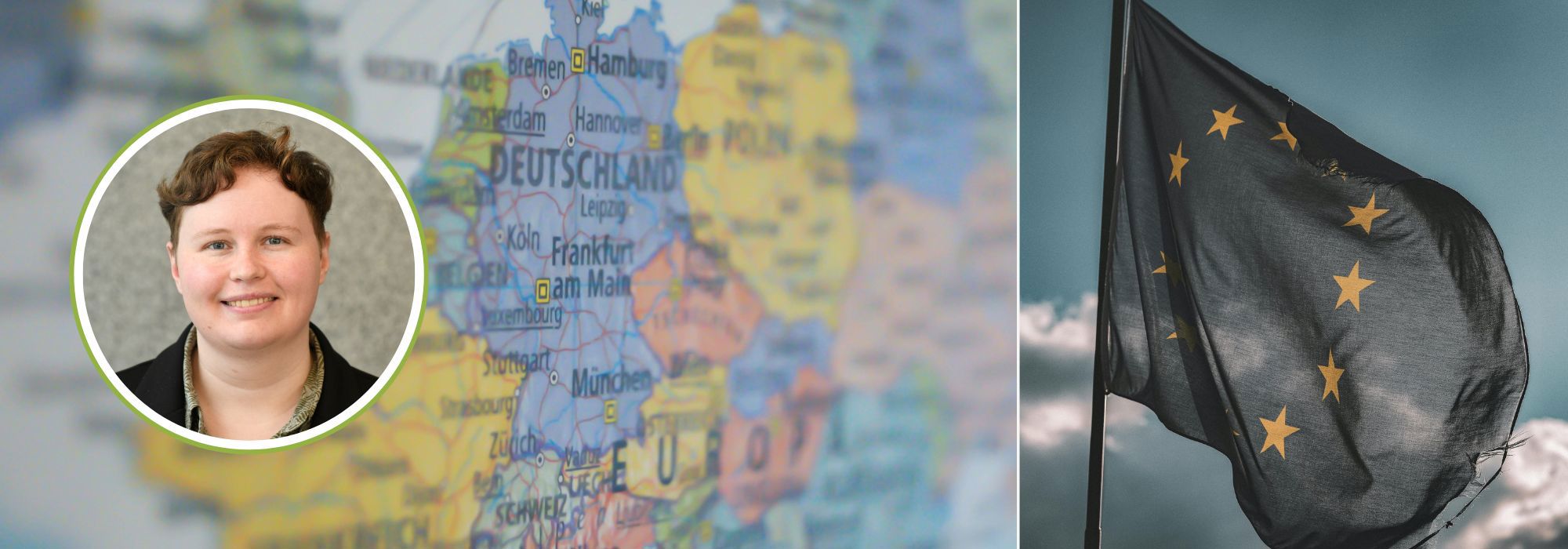
`Fragmented tax rules hinder the free movement of goods, services, capital and labour,´ says Theresa Bührle, one of the researchers behind a new EU report that will be presented in Brussels next year.
The European Parliamentary Research Service commissioned a major new report on what it calls the “cost of non-Europe” in taxation – the economic and administrative losses that arise when EU Member States design and enforce tax rules in isolation rather than in a coordinated way.
`In other words, we have written an extensive report on what economic losses and administrative burdens arise when EU Member States design and enforce tax rules unilaterally rather than coordinating with other countries, Theresa Bührle says.
We do not pretend to have all the answers. But we show clearly where fragmentation in tax policy is already creating costs.
Theresa Bührle
Bührle, Assistant Professor at the Department of Business and Management Science, has been part of the expert team behind the project.
The report, The future of EU tax policy harmonisation, will be presented in Brussels in January.
`We do not pretend to have all the answers. But we show clearly where fragmentation in tax policy is already creating costs. Carefully designed coordination could add real value without taking away national sovereignty. That is the debate we hope to encourage, ´

The report focuses on the taxation of wealth and crypto assets as well as digitalisation and compliance burdens.
Taxation remains primarily a national competence. The EU has limited legal capacity to harmonise tax rules. Any joint initiative must be justified by the functioning of the single market and typically requires unanimous support.
`Fragmented tax rules can hinder the free movement of goods, services, capital and labour. Divergent definitions, valuation rules and procedures generate extra reporting obligations, higher compliance costs, and gaps in enforcement. In some cases, they may even influence where businesses invest and where wealthy individuals choose to reside, ´Bührle says.
Fragmented tax rules can hinder the free movement of goods, services, capital and labour.
Theresa Bührle
Wealth taxation is one of the clearest examples of divergence: some EU States retain broad net wealth or property taxes; but most levy only limited real estate taxes. The current landscape is fragmented with varying tax bases, rates, and exemptions.
According to the report, such divergence may incentivise high-net-worth individuals to relocate, distort competition, and weaken equal treatment between taxpayers of similar means.
The report The future of EU tax policy harmonization (delivered to the European Parliamentary Research Service) focuses on four areas where national fragmentation already affects the single market; wealth taxation, crypto asset taxation, digitalisation of tax administration and tax compliance burdens. The report combines legal analysis, comparative descriptions of national systems, case examples, and evidence from existing research.
`There is a renewed debate about wealth taxation in Europe, ´ Bührle says.
Although the report focuses strictly on EU countries, she believes Norway offers a useful perspective.
`Norway made a different choice than most EU countries. It kept the wealth tax and abolished the inheritance tax, whereas many Member States did the opposite. Norway has long-term experience with defining and measuring taxable wealth, supported by high transparency and digitalised tax systems. Although or maybe even because the Norwegian wealth tax regime remains heavily discussed, I think there is something to learn from that when Europe debates new wealth-tax instruments.´
On crypto assets, the report finds huge variations.
`Crypto is a new type of investment that is currently under-regulated in many places. And depending on whether crypto is treated as a financial investment or an asset of purchase, you end up with very different tax outcomes. ´
She notes that this topic is also relevant for Norway.
`Even in a country that is quite advanced in digital reporting, the inherent anonymity of crypto creates challenges. The EU’s new reporting standards for crypto transactions will be very interesting to follow – both inside the Union and for close partners like Norway.´
The report also examines how tax is administered. Here, differences between Member States are striking. Countries like Denmark – and, in Bührle’s experience, Norway – are at the forefront of digitalisation, using pre-filled tax returns, online communication and extensive third-party data.
`Research shows that pre-populating tax returns with correct information increases compliance, ´ Bührle notes.
`When taxpayers see that the tax administration already knows a lot, they are more likely to report honestly. ´
When taxpayers see that the tax administration already knows a lot, they are more likely to report honestly.
Theresa Bührle
Finally, the report looks at tax compliance burdens, which fall especially heavily on SMEs and firms operating across borders. Divergent procedures can become barriers to doing business in more than one country.
`The report proposes steps such as more standardised reporting requirements, ´ Bührle says.
Member States could learn more systematically from each other – for example through forums where they share best practices – and the EU could help provide the infrastructure and resources, especially for countries that simply lack capacity.