The Silver Innovation Gap: From “Burden” to “Untapped Resource”
The aging population is often framed as a looming burden—on welfare systems, healthcare, and productivity. Yet this perspective captures only half the story. The same demographic shift is also creating one of the largest and least exploited economic opportunities of our time: the Silver Economy.
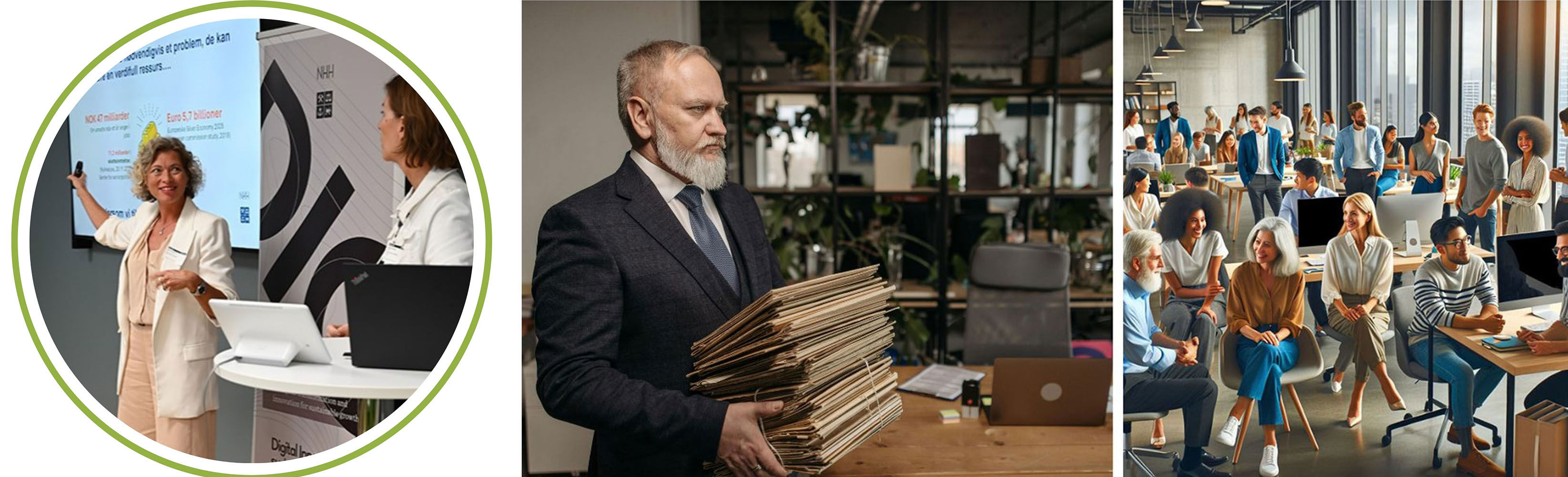
The Silver Economy encompasses the activities that enable older adults to live healthy, active, and productive lives. In Europe alone, it is estimated at €5.7 trillion by 2025. This is not a niche—it is a structural transformation reshaping demand, labor supply, and innovation across sectors.
And yet, despite its scale and urgency, many firms continue to treat aging as a constraint rather than a catalyst for innovation. Norway illustrates this paradox clearly. Older adults are wealthier, healthier, and more digitally active than previous generations. Many remain engaged in work, while others contribute significantly through volunteering and informal activities. They are not dependents on the margins of the economy—they are active participants within it. Still, businesses continue to prioritize younger consumers and talent. This reveals a persistent mismatch between demographic reality and strategic focus.
The problem is not a lack of opportunity—it is a lack of innovation. Older adults clearly represent “big business,” yet firms struggle to translate this potential into products and services that meaningfully improve later-life living. While awareness of population aging is high, organizational responses remain fragmented. Innovation efforts are still disproportionately oriented toward younger users, reflecting outdated assumptions about who drives growth and adopts new solutions.
The result is what we might call a “Silver Innovation Gap”: a disconnect between where value is emerging in society and where firms are directing their innovation efforts. The consequences are significant. Too few products and services genuinely enhance life for aging populations—and too many opportunities for sustainable growth remain unrealized.
Businesses are not lagging because the challenge is too complex, but because their mental models are outdated. Older adults are still widely perceived as less innovative, less digital, and less relevant. All three assumptions are increasingly false. In reality, older adults represent one of the most stable, growing, and underutilized sources of both demand and capability in the economy. Ignoring them is not just a social oversight—it is a strategic miscalculation.
Closing the Silver Innovation Gap requires a fundamental shift in perspective: from deficit thinking to resource thinking. Aging should not be framed as decline, but as capability. Older adults are not just consumers with needs—they are actors with resources. They bring experience, purchasing power, and deep knowledge of the problems that innovation seeks to address.
Three Strategic Blind Spots
Recent DIG research points to three interrelated blind spots that help explain why firms continue to lag behind (Egeland et al., 2025).
1. Ignoring silver entrepreneurs
Some of the most innovative responses to aging are coming from older entrepreneurs themselves. These “silver entrepreneurs” are often more likely to introduce new products and invest in radical innovation than their younger counterparts. Yet established firms rarely learn from them. This is a missed opportunity: silver entrepreneurs combine lived experience with market insight.
2. Excluding seniors from innovation processes
Organizations frequently design for older users without involving them. This undermines both relevance and impact. Senior employees bring deep domain expertise and first-hand knowledge of user needs—resources that can significantly enhance innovation quality. Involving them directly in innovation processes is not simply a matter of inclusion; it is a way to generate better solutions.
3. Siloing the Silver Economy
Aging is often treated as a standalone issue, competing with other strategic priorities such as AI, digitalization, and sustainability. As a result, it is deprioritized. But the real opportunity lies in integration. The Silver Economy should not compete with other transformation agendas—it should be connected to them. For instance, aligning AI adoption with an aging workforce can unlock both productivity gains and new forms of value creation.
The Centre for Extended Working Life was approached by DIG professors Therese Egeland and Inger Stensaker as they wanted to apply to the Norwegian Research Council for a project into the “silver economy”. They have stayed on as a partner since.
Turning Silver into Gold
Firms that continue to operate with outdated assumptions about age, value, and innovation risk are overlooking one of the most significant growth opportunities of our time.
A provocative insight emerging from recent DIG research is that older workers may be better positioned—not worse—to leverage generative AI ( Lauen & Kvinge, 2025). While younger workers are often seen as “digital natives,” senior workers can be understood as “problem natives.” They possess deeper contextual understanding, enabling them to better interpret, challenge, and refine AI-generated outputs. Rather than viewing seniors as technology laggards, firms should recognize them as critical actors in AI-driven transformation.
Firms that continue to design for “decline” will miss the market. A strengths-based approach—emphasizing agency, contribution, and co-creation—is not only more inclusive; it is strategically superior. The Silver Economy is ultimately a test of whether firms can recognize value where they have long been conditioned not to look.
For now, most are still looking the wrong way.
References:
Egeland, T., Heinonen, K., & Stensaker, I. G. (2025). The Silver Economy: A Business Perspective on the Aging Society. The Journal of Applied Behavioral Science, 00218863251397563.
Lauen, S. Ø. & Kvinge, E. K. A. (2025). Når konsulenter møter kunstig intelligens: En kvalitativ casestudie av hvordan nyansatte og seniorer opplever kunstig intelligens i arbeidshverdagen. Masterutredning, Norges Handelshøyskole.