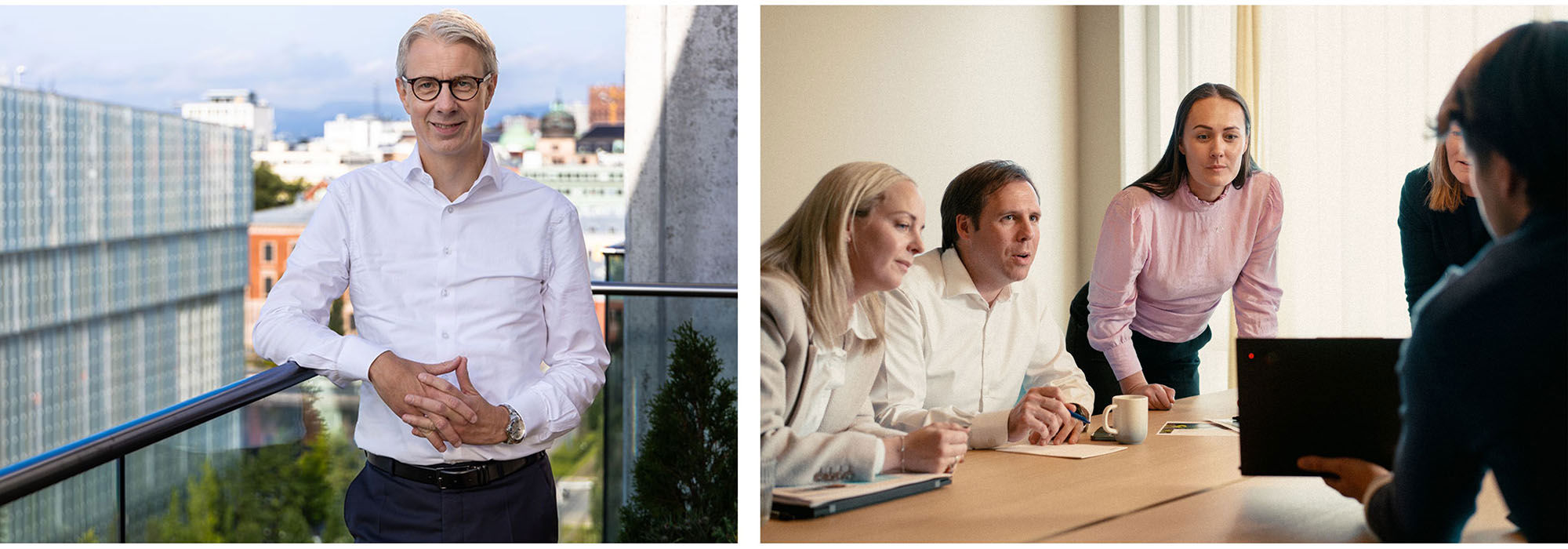
Head of Audit in KPMG Norway, Anfinn Fardal - and an illustration on how revealing new and better findings from AI in auditing might look. All photos: KPMG
Over the past year, the pace of change in auditing has accelerated dramatically. For DIG partner and auditing and advisory firm KPMG, artificial intelligence is no longer just a supporting tool. It is becoming an integral part of how audits are planned, performed and delivered.
-Things have really accelerated over the past year, says Anfinn Fardal, Head of Audit at KPMG Norway.
AI has moved from being an efficiency enhancer to fundamentally changing how we approach auditing. When combined with our human competencies and established methods we can measurably improve audit quality.
From cloud to AI-driven auditing
KPMG’s journey towards AI-enabled auditing did not start overnight. The foundation was laid as early as 2018, when cloud-based services were introduced as part of a broader modernisation of audit delivery.
- In 2024, we integrated generative AI into our audit tools to systematically aid our auditors with summarising information, supporting our professional judgement and suggest potential improvements. Combined with our audit methodology, this has allowed us to raise both efficiency and quality in our work, Fardal explains.
Introducing AI was a natural next step in a longer transformation process aimed at strengthening audit quality, relevance and trust in an increasingly complex business environment.
AI agents introduced in 2025
The most significant leap came in 2025, when KPMG introduced AI agents into its audit processes.
- These agents can now perform end‑to‑end tasks in an audit. They review all transactions, analyse contracts and supporting documentation, and identify obligations or commitments that may not be adequately reflected in the accounts. But our auditors are always in the loop, says Fardal.
The value of this capability becomes particularly clear when auditing large and complex projects, such as shipbuilding or infrastructure developments. In these cases, AI agents are able to read and analyse extensive volumes of contracts, credit agreements and documentation, identifying accounting-relevant elements that would otherwise be extremely time‑consuming to review manually.
- It’s almost stunning to think of how much more data we are able to analyse and review, compared to when I first became an auditor, and how much more insights into the business the audit process delivers, Fardal says. I don’t think there’s ever been a more exciting time for our field of expertise.
The NTNU (Norwegian University of Science and Technology) will head the upcoming Norwegian research centre “AI for Decisions” (AID). They will work with DIG and use expertise from DIG on AI as an organizational and management challenge.
Moving beyond the “needle in the haystack”
Traditionally, auditing has relied on statistical sampling by selecting a representative subset of transactions and documents in order to form an opinion on the whole.
- Our AI transaction scoring system analyses every single transaction a client has recorded and assigns each a risk rating: Low, medium, or high, Fardal says. That way, we can immediately zero in on the high-risk transactions. It’s no longer about searching for a needle in the haystack by sampling; the AI examines the whole haystack so we don’t miss anything important, he adds.
This allows the auditors to focus their attention, together with the client, on the transactions that truly matter.
This represents a fundamental shift in both method and mindset. Rather than spending time identifying samples, auditors can work more precisely and proactively.
- We are much more targeted in the questions we ask, and far more confident that we have covered all relevant ground, he says. That makes our collaboration with clients more efficient and more valuable, he continues.
From a new tool to a new way of working
According to Fardal, the biggest change is not technological, but cultural.
- These AI agents are not just another tool, they have become an integral part of the team’s workflow They represent a new way of working. In many ways, they are like colleagues and they need to be guided, trained and controlled, just like people, he says.
This requires new skills and new forms of professional judgement. Auditors must understand how the technology works, where its limitations are, and how to apply human expertise on top of machine‑driven analysis.
- For us, this is about strengthening audit quality and trust, Fardal emphasises. Technology helps us see more, but professional judgement remains essential, he adds.
Human expertise remains critical
Despite the rapid adoption of AI, Fardal is clear that technology will not replace human auditors.
- We will still need a lot of specialists in five years, he says. We are not going to stop hiring, he says.
On the contrary, he believes AI will accelerate professional development within the firm.
- By spending less time on routine tasks, our people can focus more on complex issues, judgement and insight. AI also gives us new opportunities for training and competence development, helping auditors build expertise faster than before, he says.
Clients are already seeing the benefits
According to Fardal, clients across a wide range of Norwegian industries are responding positively to the new approach.
- The new tools has generally been very well received, he says. It gives clients insights into their own businesses that they simply didn’t have before, he says.
In his view, this marks a broader shift in what clients can and should expect from an audit.
- This is not just about efficiency, because the audit process still requires huge investments in people, hours and technology, Fardal concludes. It’s primarily about delivering higher quality, better insight and stronger trust. We believe this will raise expectations for the entire audit profession, and that is a development we welcome, concludes the Head of Audit in KPMG Norway.